Lisbon

View from the rooftop bar at Hotel Chiado in Lisbon

After a long weekend, this ended up being a three-day working week followed by a short break with my family. We have a lot going on this summer, with both A-Level and GCSE results, our youngest making the pilgrimage to Reading Festival, and our eldest looking to get a visa and make a move to the US for university college. Conscious that there may not be many more holidays that we’ll all spend together, we were keen to get away, so we started looking for a destination for a short break. Lisbon seemed to be exactly what we were looking for. We found some cheap flights and a centrally located hotel, and we were on our way. It didn’t disappoint.

We flew from London Luton to Lisbon (not easy to say quickly), zipped through the airport and took an Uber to our hotel. Everything was seamless from the moment we landed. The airport is conveniently located close to the city, but far enough away that the planes don’t trouble you when you’re there.

Our orange and white Cooper Black-adorned chariot

We stayed at Brown’s Central Hotel, which turned out to be a perfect spot in the centre of the city. We wanted something centrally located and it’s literally in the name. The hotel is situated on a corner within the small grid system of avenues and streets that were established when Lisbon was rebuilt following the devastating earthquake of 1755. From here we could wander around the grid, passing the incredible number of restaurants with their street dining areas, head east or west into the historic, hilly sections with winding passages and stairs, or south through the Rua Augusta Arch, into the Praça do Comércio , down to the riverfront and the port.
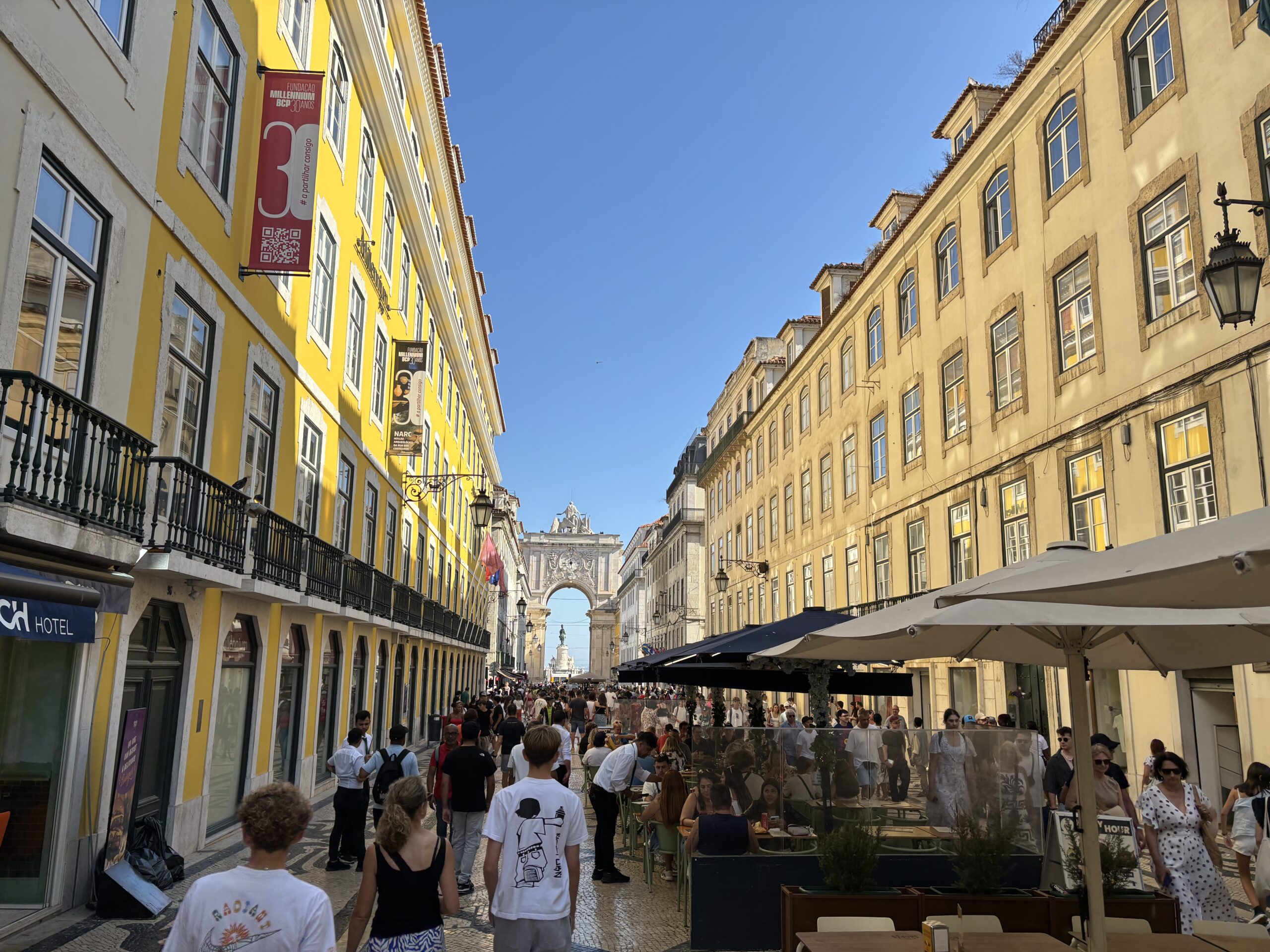
Looking south down the busy, restaurant-filled Rua Augusta towards the Arch
The Rua Augusta Arch, the Praça do Comércio and the statue of King José I, by Machado de Castro

I’d anticipated that it would be a food-based holiday and I wasn’t disappointed. After dropping our bags off at the hotel we headed out to explore, almost immediately bumping into a little shop called Castro selling pastéis de nata. We insisted that we didn’t need a fancy cardboard carry case for our four pastries as they would have an estimated lifespan of sixty seconds after being handed over to us. So they popped them in individual little bags. They were delicious. Later on in our trip we stumbled across the original historic home of these pastries in Belém and ordered some more. They were good but — with apologies to their secret recipe — perhaps not quite as delicious as those we had on our first day.

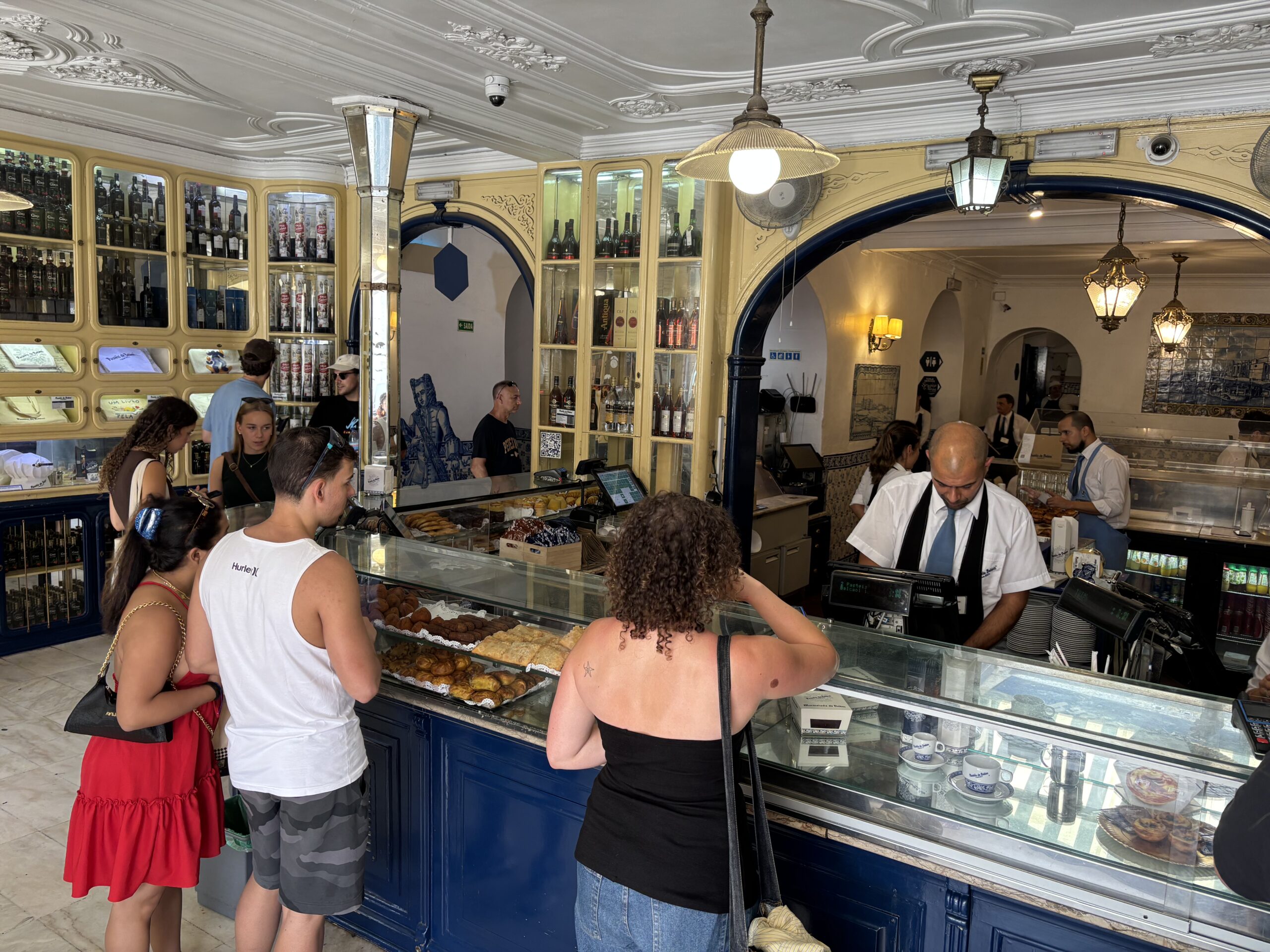
Buying a pastel de nata from the fabulously posh-looking Castro
The historic counter at Pastéis de Belém

For a follow-up snack, one of the boys navigated us to The Potato Project, a small shop selling cones of deliciously cooked chips all dressed up with various toppings. We usually love mushy peas with our fries, but I could see a business like this doing a brilliant trade in the UK.
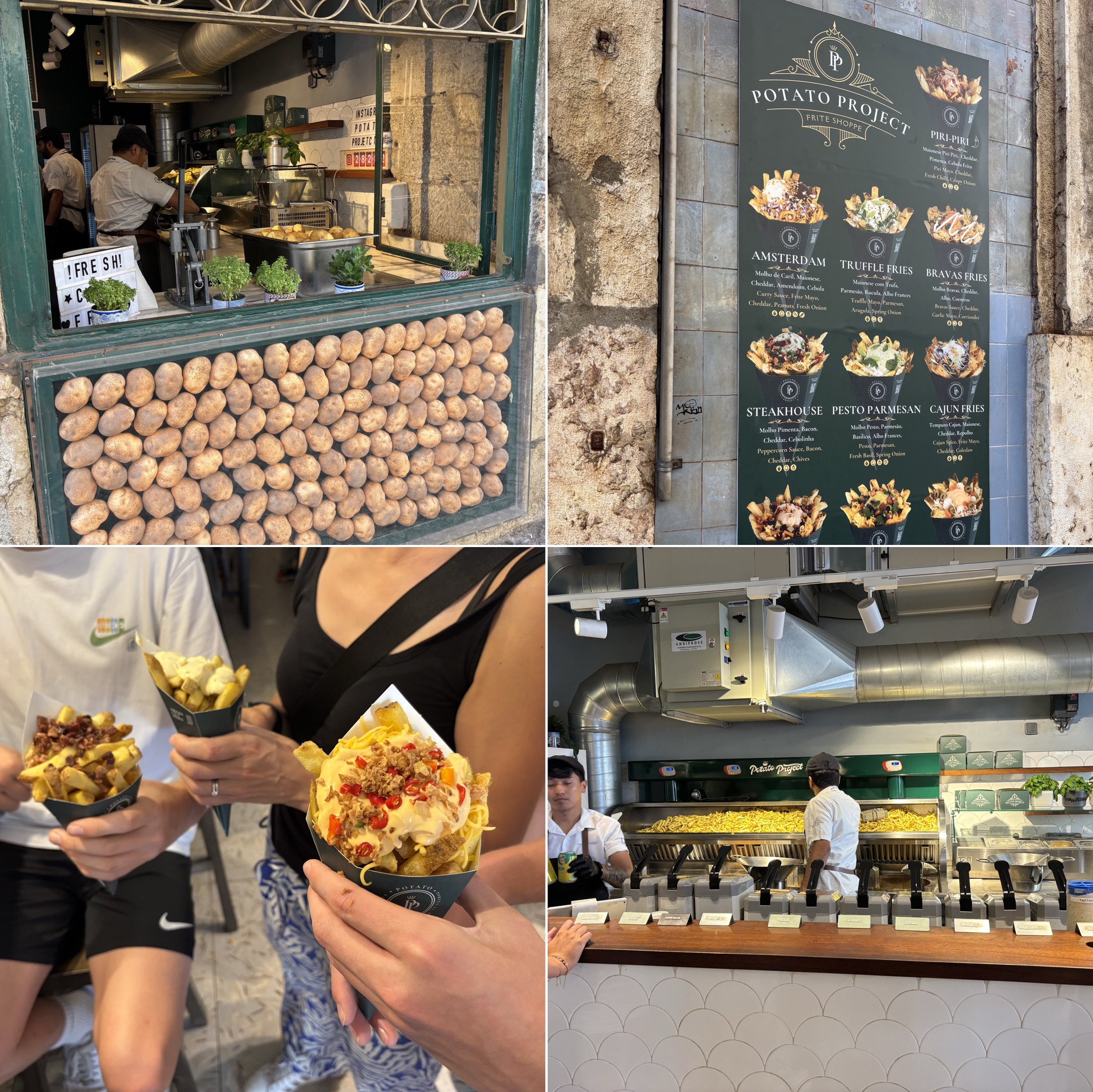
Views of The Potato Project, Lisbon

For dinner, we took a short walk to Restaurante O Chiado which had exceptional reviews on all of the websites we looked at. It was my kind of place, with only 20 seats in a little room with an authentic, rustic feel. After seeing a sizzling dish being brought to another customer’s table, we started with a plate of fried shrimp in olive oil and garlic to share, along with some bread to mop up the sauce. The tastes were incredible. For a main course, the boys both ordered ‘steak on a stone’, which according to one of our boys turned out to be “one of the top three meals I’ve ever had in my life”. After equipping them both with bibs, the raw steaks turned up alongside possibly some of the hottest objects ever known to man. They sat at the table, gently cooking their steaks until they were just how they liked them. My wife and I ordered the monkfish with rice and shrimp, which was also superb. We finished up with some small desserts and waddled back to our hotel, fully satisfied with a wonderful meal.

Steak on a stone, times two
Monkfish with rice and shrimp. Absolutely delicious

The boys spent some time mooching about on Lime e-scooters, and eventually persuaded my wife and I to join them. They ended up being a fun and practical way to get around the city; the breeze from travelling around at speed compensated for the 35°C heat.
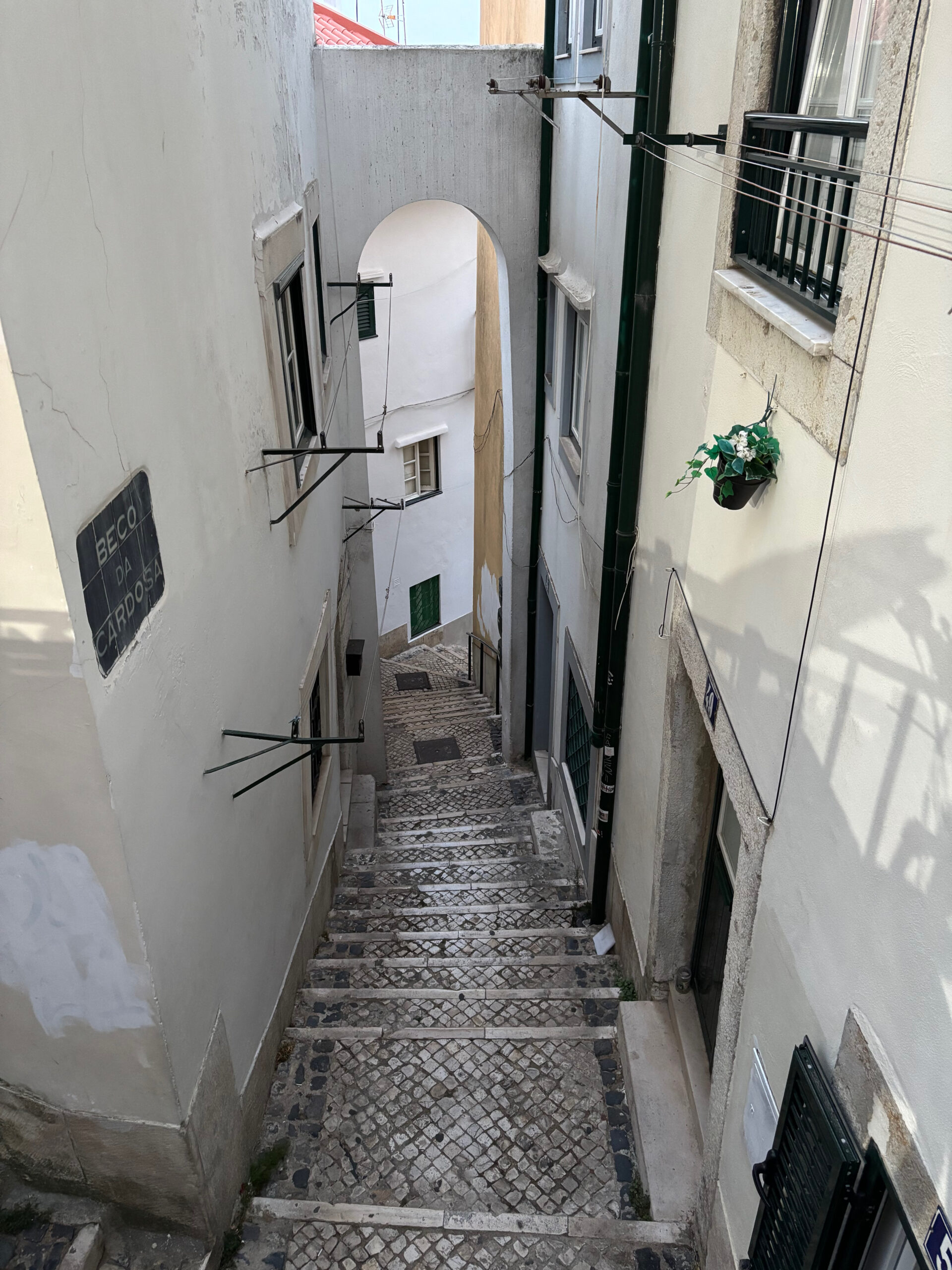
Outside of the main centre, there were so many narrow, winding passages to explore

They told us that they had seen people travelling around in groups in small electric cars run by Spinach Tours and thought it looked fun. We checked out their website and found that we could reserve two cars at a discounted ‘early morning’ rate for the next day for €160, so we booked ourselves in.

On the road in our Spinach Tours cars

They took a very loose approach to verifying that we were safe to go out in the cars on the roads. Despite my youngest son only having passed his test in the past year, they only wanted to see two of our driving licences for insurance purposes. Not knowing quite what to expect, we paid a €15 insurance premium per car to limit any damage to a €600 excess for each. The lady who checked us in told us that “nobody has ever been hurt in our cars”, but followed it up by telling us that their worst accident was when someone drove one of the cars through the window of a shop. Everyone was fine, but the shop was not.

The cars were simple to operate, with motorbike-style controls including a ‘twist’ accelerator on the right-hand handlebar. There was a single pedal for the brake, and a rocker switch for the indicators that you had to deactivate manually. It took a little bit of getting used to, particularly when trying to do a hill start; you had to turn the accelerator, wait for three or four seconds and then release the brake. The other vehicles around us were mostly tolerant as we got used to them on the roads. Once we got used to them we found ourselves zipping along the faster roads at 45km/h.

Each car had an Android tablet in a magnetic case, which stuck onto the dashboard, showing you a map of where you are and where one of the various predetermined routes were. If you started driving along one of the routes, audio would kick in to act as your guide and tell you what you’re looking at. The app included suggested places to stop, get out of the car and look around, but in practice we found that everywhere was too busy for us to pull over and park up.

The biggest downside to the cars was how uncomfortable they were. We hired them for three hours but bailed out after two and a half. You couldn’t adjust the seats in any way. Both my butt and my leg were in agony from sitting in an awkward position, and I found myself taking my foot away from the brake pedal to stretch it out in the rest of the footwell as we went along. I couldn’t have driven one for much longer. It was fun, but I was glad to get out and get walking again.
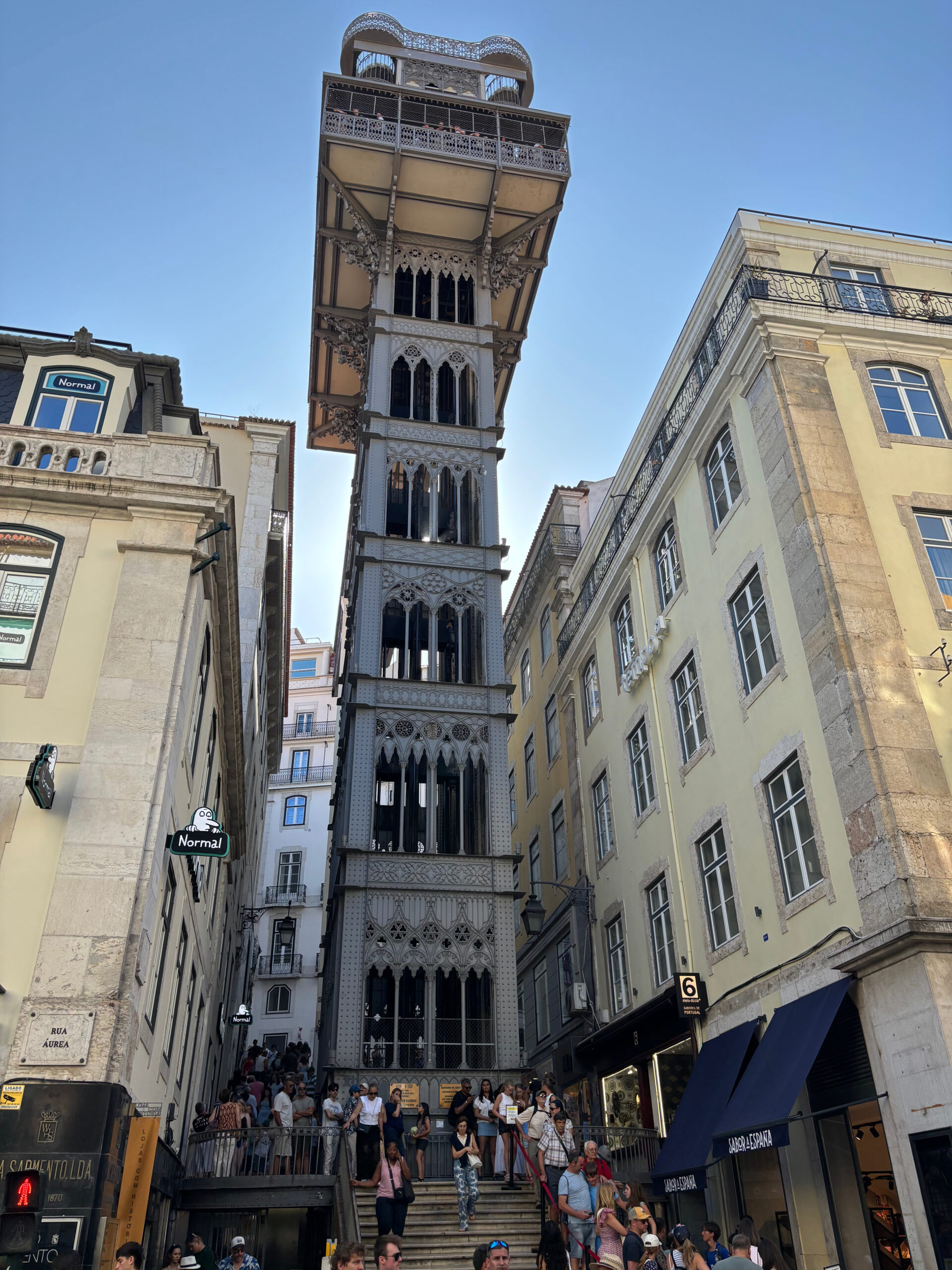
The Santa Justa Lift, Lisbon

As you would expect from a capital city, there is lots to see in Lisbon and we barely scratched the surface in the three-and-a-bit days that we were there. The Santa Justa Lift was located very close to our hotel and we were more fascinated by the ever-present crowd of people paying to ride the elevator to the top than we were about the structure itself. Heavy trams rumbled everywhere, seemingly defying physics as they scaled the steep streets.
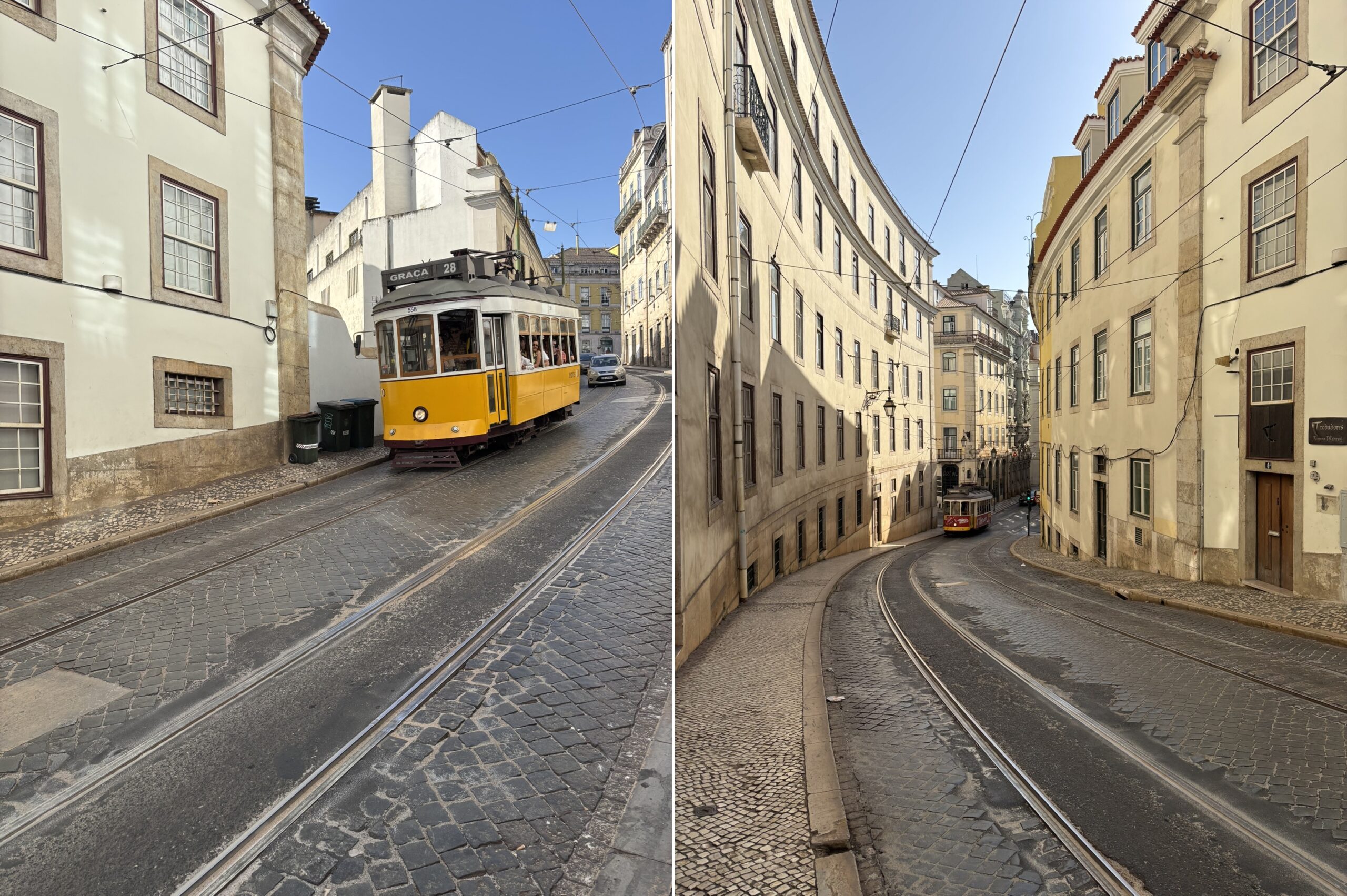
Trams heading up and down the steep hill of Calçada de São Francisco

Our gastronomic journey continued with a visit to the Time Out Market, a big food hall with a host of independent vendors and communal seating. It was bustling with people. One of our boys impressed us with his desire to try something he’d never had before, going for an octopus hot dog with tiny fries.

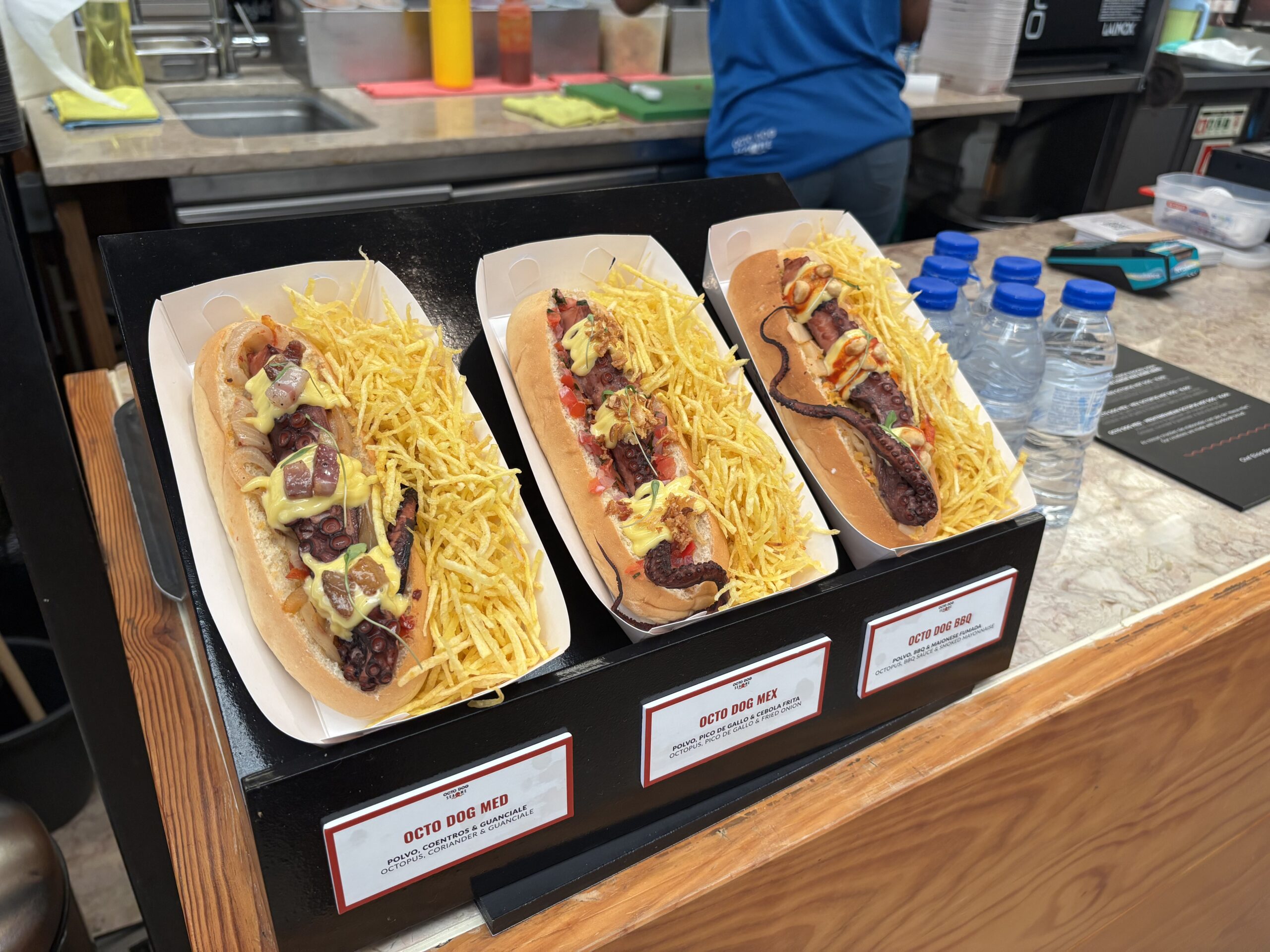
Time Out Market, Lisboa
Octodogs
Octodogs

We came across Crush Doughnuts close to our hotel and couldn’t resist stopping to sample them. The doughnuts are massive; even sharing two between four of us was more than enough.

Crush Doughnuts: peanut butter on the left, Biscoff on the right

It was fun to wander along to Lupita Pizzaria, a highly-rated pizza joint in a part of the city we hadn’t been to yet. We walked down Pink Street, past a bunch of funky small bars that looked geared to tourist crowds, as well as the smallest bar I’ve ever seen, which could literally be filled up as soon as you get four or five people in there. When we got to Lupita Pizzaria, we found a big crowd gathered around one of the doors and worried that we had arrived too late. We started thinking that maybe we should try elsewhere, but ultimately decided to stick with it. We gave our name to the lady at the door, who wrote it on a list on one of the glass door panels. We also found that she would serve us drinks from the door, allowing us to relax a bit while we waited for a table to come free. We struck up a great conversation in the queue with a guy from the US and his two sons who were holidaying there.
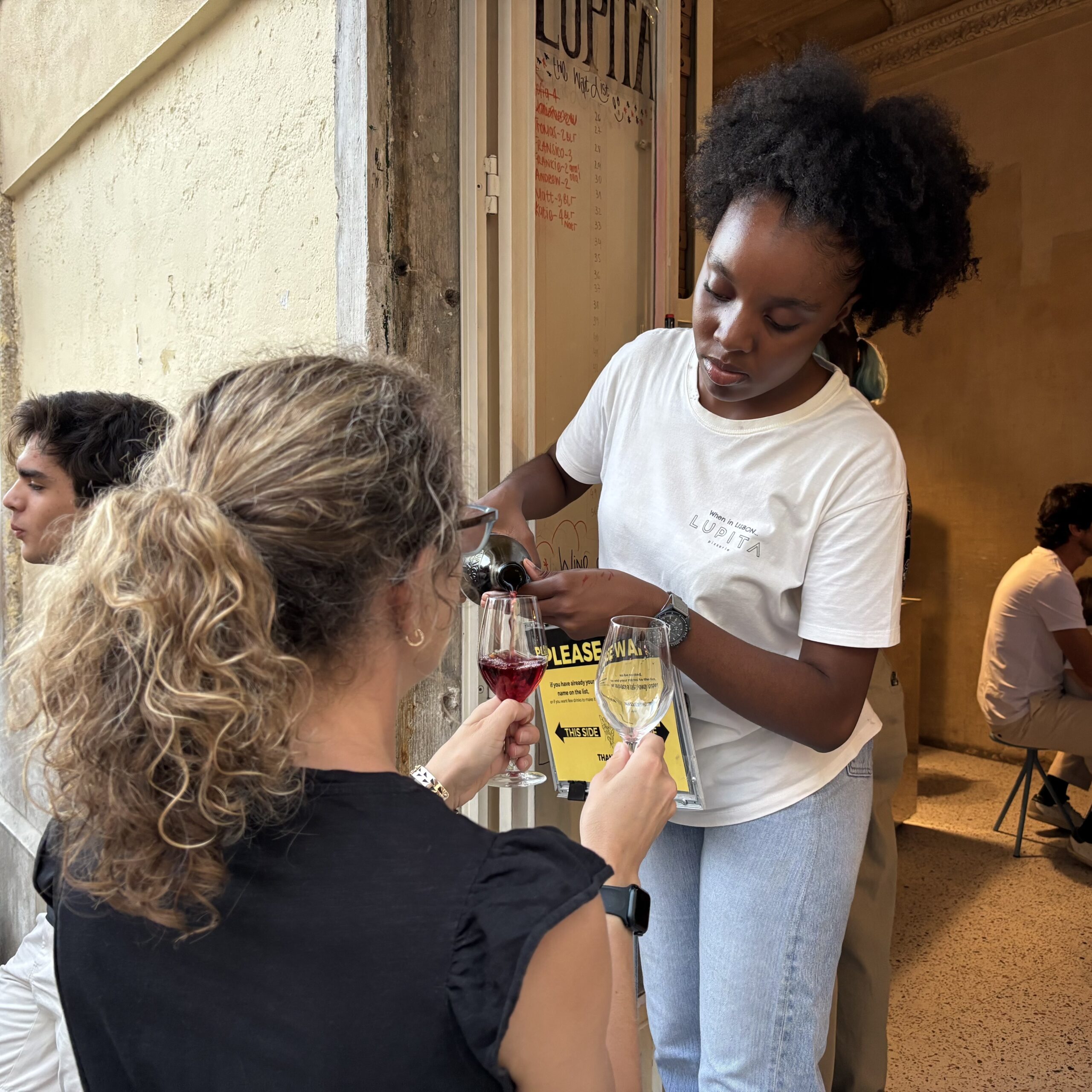
With our name on the door at Lupita Pizzaria, we decided to order drinks

Once we eventually got into the restaurant, we understood why it took some time. The place was very small, with just a few seats at a handful of tables. The menu was extensive, and I was excited to try a vegan pizza with mushrooms while my wife opted for a pizza covered in shaved courgettes. They were delicious, but I couldn’t finish mine.

Courgette pizza on the left, vegan mushroom pizza on the right

Breakfast is my favourite meal of the day. We managed to find some lovely places that sold all of the great breakfast things, from avocado toasts, to eggs, to açai bowls with granola. The Folks and Dear Breakfast were both excellent, but on our last day in the city we discovered Miolo, which was on another level. The décor was beautiful, with gorgeous, comfy seats and wallpaper which made a statement without being overwhelming. Someone with a very keen eye for interiors had gone to town on the place. But it wasn’t style over substance; the food was delicious.

Miolo, Lisbon. Amazing décor, even more amazing breakfasts

One evening we sought out pasta at Osteria Bellosguardo, an intimate Italian restaurant in the middle of a bunch of narrow, winding streets. The whole area around the restaurant had a wonderful rustic feel; old men with old, sleepy dogs sat on benches, chatting and watching people walk by. As we walked away after our meal we came across someone’s laundry airer placed in the middle of the street. When you don’t have any outside space, why not?

Pasta at Osteria Bellosguardo
Laundry in the street

We could hear music and singing, and followed our ears to find out where it was coming from.

Going in search of the music

We came across an alfresco restaurant where all of the diners were being treated to a performance of fado, a form of traditional Portuguese music. I don’t know what the topic of the song was, but it sounded beautiful.
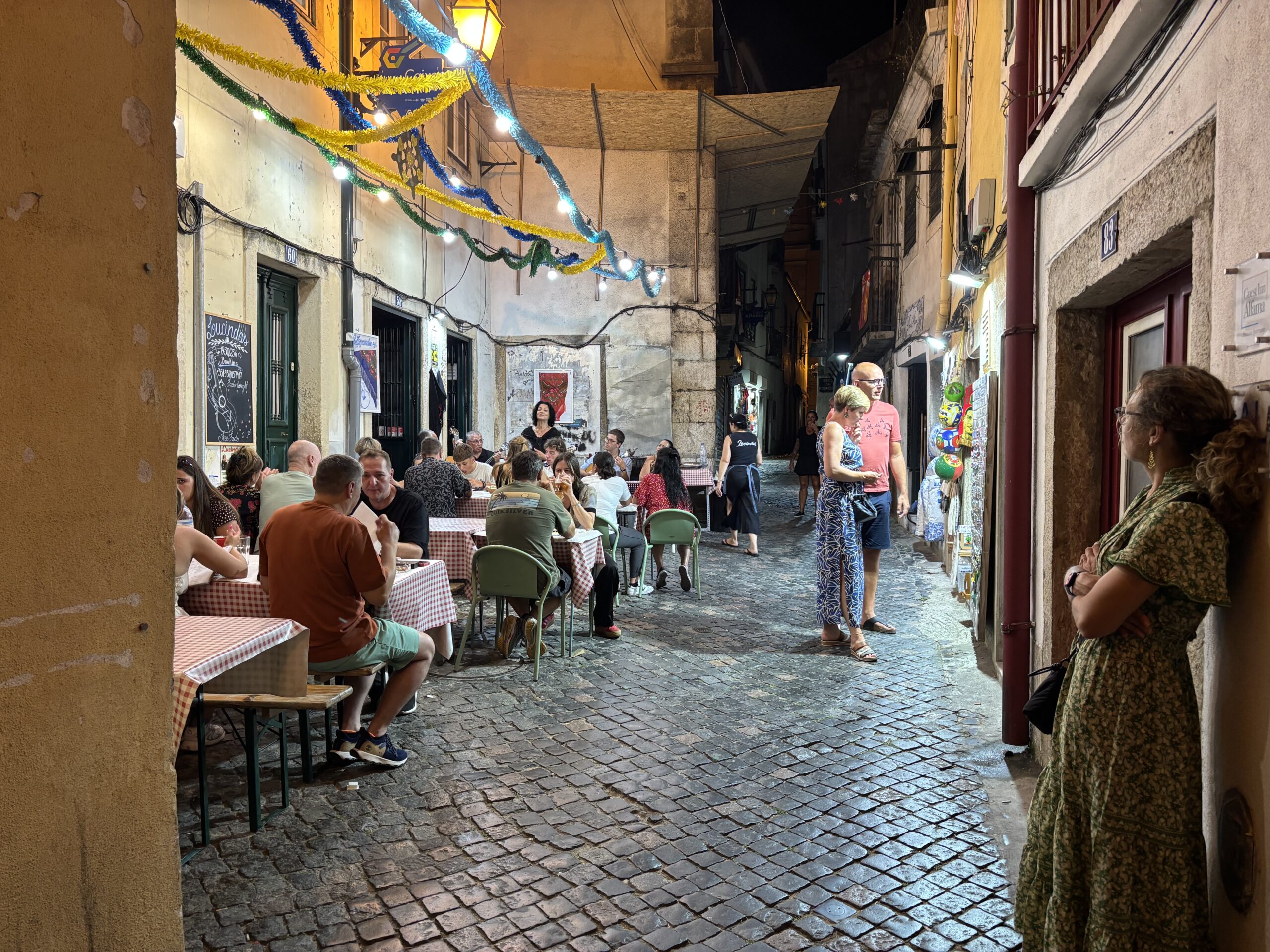
Watching and listening to the Fado players

On Sunday we took the train for an hour out of the centre of Lisbon to Sintra, which many people had suggested we include on our itinerary. Unfortunately, when we got there, the many tourist touts told us that the historical sites had been closed by the authorities due to the risk of wildfires. Disappointing, but totally understandable. We quickly decided to get a taxi to Cascais, a local seaside town. It was pretty, but we weren’t really beach ready and after a little bit of wandering around we decided to head back on the train.

Old stone street sign, Lisbon

We managed to get some runs in, heading down to the water and along the waterfront. The first day we headed west and found ourselves heading along narrow pavements in an industrial landscape. For my second run I went the other way along the river, and was greeted by a port hosting gigantic cruise ships. It’s hard to understand the size and scale of them until you are up close.

An MSC cruise ship docked at the Port of Lisbon

Some of the trauma of the 1755 calamity has been channelled into the creation of the Quake Lisbon Earthquake Museum. The reviews were good and we thought that it would be a great way to learn a bit more about the history of the city. It was less of a museum and more of an interactive experience, with a simulated trip back in time to 1755, and strict timings between each of the scenes that you visit. For the earthquake itself, you find yourself sitting on wooden pews in a cathedral, watching the start of a religious service before the shaking starts and causes havoc. We learned that Prime Minister at the time, Sebastião José de Carvalho e Melo, 1st Marquis of Pombal, led the reconstruction efforts which included the world’s first buildings to incorporate an anti-seismic design. Looking through my photos, I realised that we had already encountered the Marquis of Pombal on our trip — painted tiles in Restaurante O Chiado showed him proud of his work of rebuilding the city.

The Marquis of Pombal in Restaurante O Chiado

I found the Quake experience a little lacking, particularly for the entrance fee. Although there was plenty of information available in the different rooms, it felt as though it had been dumbed down in order to make it more of an ‘experience’.

Louie Louie record shop was a good find, with its unassuming entrance off some steps down a side street. They had a great selection of music, all reasonably priced. I picked up three second-hand CDs — Salad’s Drink Me, New Young Pony Club’s Fantastic Playroom and Turin Brakes’ Ether Song — for €5 each.

And just like that, our short holiday was over. Lisbon had one final surprise for us; straight after security at the airport, there were two conveniently located vending machines selling bottles of water for the retro price of €1. What a splendid touch.
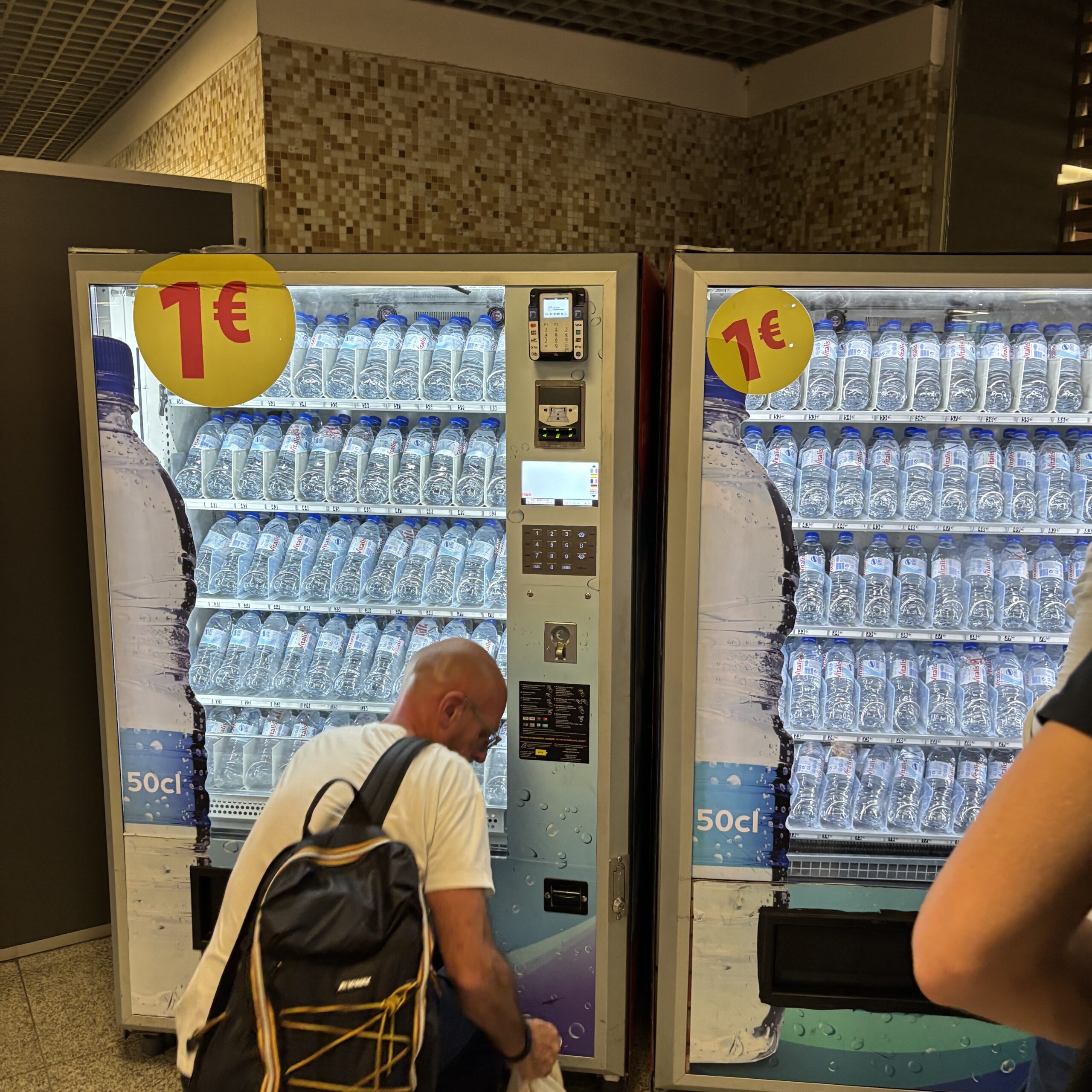
No, this was not a mirage

It was so lovely to spend time together as a family, particularly given that one of our team is about to set off on his own university adventure and won’t be at home as much. Lisbon was fabulous, and I’d definitely like to come back.

Nanny Seaside

My lovely nan, Joyce Warren, passed away late on Wednesday evening. At the start of January she had just reached the ripe old age of 93. I’m so sad that she’s gone, but so grateful that up until she went into hospital about a week ago, she was living independently in her own house. I spoke to her on the phone just before Christmas and she sounded great. She had lots of of people around her over the festive period, including her eldest daughter, my aunt, who had come back from Australia to visit.

She was such a lovely woman. She and my grandad were landlady and landlord of The White Bear pub in Hounslow, west London, when my mum and dad met. Later they owned a nearby guest house, which is the setting where I first remember her. We have a large family and have such fond memories of Christmas and New Year parties at the guest house, with uncles, aunts and cousins everywhere I looked.

Nan and Grandad were fabulous entertainers and always loved hosting get-togethers and parties. They retired to a big house by the seaside in Southbourne in Dorset, with enough bedrooms for us to be able to have many more big family Christmases together. They bought a pianola and boxes of music rolls which fascinated me; I would spend hours pumping the pedals. We’d head down to their house the summer to enjoy a day at the beach. At just the right moment, nan would pull out choc-ices from the deep freezer or find a big box of sweets that we could take one from. They were such happy times.

Whenever I think of my grandparents, this photo is the first thing that comes to my mind. It was taken on Christmas Day in the late 1980s. (That’s me in the background in the blue top.) My nan and grandad look so content, so happy that they had their family around them. I don’t think they knew someone was taking the photo at the time. It’s my favourite picture of them.

At my wedding in 2004 I had that photo in my mind and asked our photographer to take one of my wife and I in a similar pose. It’s a bit exaggerated, but I wanted to somehow capture the happiness and love of life that they had in their photo.

Sadly, my grandad passed away in Christmas 1991, leaving my nan on her own. He left a big hole in our lives. Nan kept going, re-learning to drive so that she could get around town independently, and still having lots of us over to visit.

She had such a wonderful sense of humor. As kids, a family joke developed where my brothers and I gave our mum the nickname ‘Mumm-Ra’, after the character in the Thundercats cartoon. Of course, the natural extension of this nickname when applied to your nan is ‘Nan-Ra’. Last Christmas, a card dropped through our door from my nan which gave me such a chuckle.

As I grew into an adult, life got busy and I feel — I know — that I didn’t pop down to see her enough. But when I did see her it was always lovely. There was nothing quite like talking to Nan about the times before I was around, hearing about her life and the things that had happened in the pub. When someone passes away, the hardest thing is knowing that you won’t be able to talk to them again.

When her great-grandchildren started to appear she picked up the nickname ‘Nanny Seaside’ which everyone now seems to call her. Nanny Seaside, we’re missing you already.

📚 Everything You Need to Know About the Menopause

There are some things that happen in life that people don’t talk about, despite the commonality of the experience. Recently, a group of my online friends started discussing their, and their partners’, experience of the menopause. One person shared with the group, and all of a sudden the stories came pouring out. I knew the basics, but I didn’t realise how much of a difficult — and sometimes devastating — experience it could be.

My wife and I are both 45 so it felt like a good time to learn a lot more about it. Kate Muir’s book, Everything You Need to Know About the Menopause (but were too afraid to ask) is an excellent place to start.

The key points I took from the book were:

  • Dealing with the effects of the menopause over a long period of time is a relatively recent phenomenon. In the Victorian era in the UK, people used to die at the average age of 59. With average life expectancy now extended by thirty years, women have to live in a post-menopausal state for much longer.
  • There is nowhere near enough education about the menopause. We learn about puberty at school but not about what happens to half of the population in later life. Given how reluctant people are to talk about it, access to information can be difficult.

The divide between those who have menopause support and knowledge and those left to suffer is massive.

  • More worryingly, the lack of education also extends to the medical profession. The book contains horrific stories of undiagnosed and misdiagnosed patients, including the case of one woman ultimately being given electroshock therapy after being diagnosed with ‘treatment-resistant depression’. It turned out that her symptoms were caused by hormone deficiency:

Although the menopause will happen to every woman in the world, and has massive health consequences, according to a Menopause Support investigation, 41 per cent of UK medical schools do not give mandatory menopause education.

… in one study of around 3,000 British menopausal women, after complaining of the onset of low mood or anxiety, 66 per cent were offered antidepressants by their doctor instead of hormones.

  • Some good news is that there is freely-accessible information out there for medical professionals, for example this 90-minute video from Dr Louise Newson on assessing perimenopausal and menopausal women, and safely prescribing HRT during remote consultations:

  • Menopause leads to other major health issues — osteoporosis (brittle and fragile bones), Alzheimer’s (dementia) and heart disease. There are some things you can do to combat a reduction in bone density, such as high-impact exercise, but on their own they are not as effective as when they are combined with Hormone Replacement Therapy (HRT). Using body-identical transdermal estrogen after the age of 50 halves a woman’s chances of breaking a hip and reduces her chances of having a heart attack.
  • A Women’s Health Initiative study in 2002 made people extremely wary of HRT. It turns out that there are different types of treatment; compounded ‘bioidentical’ tablets are awful as there is no reliable way to know what they contain, whereas body-identical hormone cream does not carry the same risks:

We need to question the conventional wisdom, which says that HRT causes breast cancer and that the risks of taking HRT outweigh the benefits. What most people – including me, until I began my investigation – think they know about HRT is wrong on two counts: every form of HRT is not the same, and the terrifying cancer-scare headlines which erupted with the Women’s Health Initiative Study back in 2002 refer to the older, synthetic forms of HRT that have now been superseded by a completely different products.

The bad news: In the general population, 23 cases of breast cancer will be diagnosed per 1,000 women. If women take the old, synthetic HRT, an additional 4 cases appear. If women drink a large glass of wine every day, an additional 5 cases appear. If women are obese (BMI over 30), an additional 24 cases appear. The good news: If women take 2.5 hours of moderate exercise per week, 7 cases disappear. If women take estrogen-only HRT, 4 cases disappear.

  • The experience of the menopause is yet another burden for women that can hold them back in their careers. It typically turns up at a time when they already have a lot on their plates, trying to sustain a career whilst dealing with moody teenagers and ageing parents. Hot flushes can be debilitating. Thanks to reports on COVID-19 we have heard a lot about ‘brain fog’; unfortunately this is another symptom of the menopause:

When scientists ask menopausal women about their symptoms, 80 per cent report hot flushes, 77 per cent report joint pain, and 60 per cent memory issues. Aside from these three, further plagues of the menopause include: heart palpitations, sleeplessness, anxiety, depression, headaches, panic attacks, exhaustion, irritability, muscle pain, night sweats, loss of libido, vaginal dryness, body odour, brittle nails, dry mouth, digestive problems, gum disease, dry skin, hair loss, poor concentration, weight gain, dizzy spells, stress incontinence – and last but not least, something that might be from a horror movie: formication, which means an itchy feeling under the skin, like ants. I had that. Quite simply, the majority of women battle through the menopause, and only a lucky few are symptom-free.

  • Suicide is at its highest for women aged 45–49, and at its second highest in the 50–54 age group.
  • Some women have to deal with menopause much earlier in their lives than they would otherwise expect. Early onset menopause, and medical menopause (i.e. following a medical procedure), can both be extremely traumatic. One in 40 women experience the menopause before they turn 40.
  • Women actually produce more testosterone than estrogen. According to menopause experts, testosterone is an essential hormone that should be replaced and yet it is not officially prescribed ‘on licence’ on the UK National Health Service as part of HRT. It shouldn’t be considered a ‘lifestyle drug’ just used to enhance a person’s libido, but “a life-saving hormone that will preserve [women’s] brains, bodies and long-term health.” It enhances “cognition, muscle, mode, bone density and energy.”
  • There is a ‘window of opportunity’ at the start of the menopause to begin estrogen replacement which reduces the chances of dementia and Alzheimer’s.
  • However, promising research is growing on older women starting HRT a decade or more after the menopause.
  • There is a small group of oncologists are looking at prescribing HRT to breast cancer survivors following a good recovery, used in conjunction with anti-cancer drugs such as tamoxifen. It may be that in some cases, the quality of a person’s life post-menopause outweighs the risks.

The book is a must-read. It has increased my knowledge from next-to-nothing to a broad, general understanding of something that half of the people around me will go through at some point in their lives. I’ve bought a second copy to be left in our book-swap rack at my office.

The remote or office spectrum

[Note: Based on some useful feedback, I wrote a follow-up to this post.]

I feel so fortunate to have been one of the minority of people in the UK that could work from home during the COVID-19 pandemic. I found the initial stages of the pandemic completely terrifying, and my anxiety continued throughout the whole of 2020 while it seemed that everyone around me was relaxing their guard. I’m grateful to have now had two doses of a vaccine, and based on my perception of relatively low numbers of vaccinated people getting seriously ill, ending up in hospital or passing away, I’ve been tentatively out and about in society again.

My employer has asked for UK-based staff to come back to our office in London on a trial basis from October, for around 50% of the time. I don’t envy the people involved in making the decisions around this as they will never completely satisfy everyone. I know that they have put a lot of thought and care into the decision and I think that this request probably strikes the right balance for now.

I think of ‘where you work’ as a spectrum, from completely remote to completely in the office. In the future, where will the optimal point be?

I have not heard of anyone that promotes being completely remote, 100% of the time, as ideal. Technology companies such as Automattic (creator of WordPress, which powers around 40% of all websites) or Remember The Milk (creators of a very good to-do list application that I have used for many years) pride themselves on remote working as a core philosophy, but even they bring people physically together on a regular basis. When I read Scott Berkun’s book about his experience of working for Automattic for a year, it was amazing how much of the text was dedicated to their in-person meet-ups.

The founders and leaders of Basecamp also agree:

Back in August, my company organised a get-together in Hyde Park for all of our London staff. For many people, it was their first time getting back on a train into Central London since we first locked down. At the event, people expressed very different views about how much they thought that we need to be back in the office, but everyone seemed to enjoy being together again. More than one person commented that they were happy working from home, but they hadn’t realised just how much they had missed their colleagues.

My conclusion is that it seems to make sense to be in the same place with your team, or your organisation, for at least some points in the year. But how much is the right amount?

All about me

On a personal level, aside from the terror of a deadly disease sweeping through the population, I think that I am going to have very positive memories of my experience during the pandemic. Partly I think this is because I am wearing rose-tinted glasses — I was extremely anxious for a lot of 2020, and this has definitely abated since my vaccination — but looking back I can see so many positive things to take from the lockdown.

I am a 44-year-old man who has spent 22 years at work. I have two (almost) teenage children and a wife who doesn’t currently work long hours at her job. For many years my usual pattern of work was to leave the house at 7am, commute into London, spend the majority of my day in meetings, and then to work late in order to catch up with emails and messages, and to get other work done. So many times I would grab a sandwich for dinner on the way home and arrive back after the children were asleep. Sometimes I might go a couple of days without seeing them. The lockdown forced me to see that my staying late in order to be productive had been at the expense of seeing my family. Obvious, perhaps, but I hadn’t really felt it until I’d experienced the alternative.

We are so fortunate to have a house that is just the right size to ensure that we all regularly bump into each other but also to be able to get out of each other’s way. I have a comfortable space to work undisturbed with an excellent Internet connection. During the lockdown, I swapped my morning commute for exercise and I’m now the fittest I have ever been in my life. In the past 18 months, I’ve eaten dinner with my wife almost every night. My boys and I have much better relationships for me having been around — the proportion of poor-quality time spent with them moaning about picking things up and keeping the house tidy is much lower than it otherwise would have been. I feel so lucky to have been present as my eldest son moved into his teenage years.

Now that I’ve experienced all of this, it’s a lot to give up.

Being in an office

Since I started working with my current employer in 2017, my immediate team has always been global. We support and partner with our business colleagues in cities all over the world. Pre-pandemic, it was rare for a meeting not to involve one or more people dialling in. Before Teams became so central to our day-to-day work we used BlueJeans for video calling, and I was regularly in the top three monthly users of our 55,000-person strong organisation. Many times we’ve wrestled with meetings that involved a myriad of connections, usually wasting time at the start, connecting from large meeting rooms in our main offices as well as the odd person dialling in from home or more exotic places like the back of a taxi as it travelled along streets of Hong Kong. The pandemic has been a great leveller in that it pushed us all into our individual ‘Brady Bunch’-style video boxes, and now everyone joins our meetings on an equal footing. Colleagues in other locations have told me that their experience is much better now that they have an equal seat at the table and aren’t battling to contribute while a group of people in a meeting room have a discussion amongst themselves.

Going back to the office will mean a return to hybrid meetings, which in my mind are the worst kind. There is a hierarchy of good meeting configurations:

  1. Everyone physically together beats
  2. Everyone remote, which itself beats
  3. Some together and some remote.

People are now used to putting their virtual hands up in a Teams or Zoom meeting, but what does that look like when ‘the room’ puts a hand up? Matt Ballantine has recently experimented with a hybrid workshop and his conclusion is that it can work, but it needs a lot of planning and moderation, something that we won’t have the luxury of putting in place for most of the meetings that we have. My view is that we should be encouraging people to think about what kind of meeting they are running and how they will set it up to be effective and inclusive. As technologists, we should be leading the way in showing people how to use tools such as digital whiteboards and tablet devices more effectively, bridging the gap to the utopia of all being able to be in the same place.

All teams in our London office have selected a ‘team day’ where they will be together physically during the return to office experiment. A few months ago our entire global organisation implemented ’step-back Wednesdays’, where we don’t schedule any internal meetings. If the goal of being in the same physical space together is collaboration and culture, this seems like the ideal day for us to be together. Other days are inevitably filled with meetings, almost always with someone who is not based in the same country, so we’d be stuck at our desks on Teams calls. Using Wednesdays to collaborate means that we miss out on the ‘deep work’ focus time for which they were intended, so we’ll need to see how we get on.

The office is a great leveller in that everyone has the same space to work in, no matter whether they live in a palace or a studio flat. Having space at home is a luxury, one that many people miss out on. This may play a significant role in how often someone wants to work in the office:

“For me it [working from home] means I now sit on the sofa 16 hours a day as there is nowhere else in a small flat to work. It is uncomfortable, not like sitting at a desk and my hands and arms sometimes hurt. I miss the office banter, working from home when you live on your own and in lockdown is very isolating. It is all email and not much conversation, or if it is – it’s a meeting that is much more painful to do over zoom or skype or whatever.” Woman, 60s, London… (Source: Demos — Distanced Revolution: Employee experiences of working from home during the pandemic, June 2021)

There are many other factors at play too. An office may be a safe space for some, removing themselves from difficult or violent relationships at home. The Demos report also highlights that not all home working is equal; people in higher-paid jobs are likely to have a much better time of it than those on low incomes. Some may also experience the added stress of employee surveillance such as presence and content monitoring. I am lucky in that I am able to pay for a good home broadband connection; with inflation starting to take hold again in the UK, people on low incomes may be forced to make difficult choices.

A close friend of mine works for a very well-known giant technology company, and we were reflecting on our thoughts about returning to the office. He was a much bigger enthusiast than I was. Putting aside any fears about being on a train full of unvaccinated anti-mask commuters (of which there are many), I could see why:

  • His office is walking distance from the mainline station that we both travel into so he doesn’t need to take the tube; his train fare is almost £10 cheaper per day than mine.
  • He gets three free meals a day, along with endless snacks and barista-made coffee on tap.
  • He can wear his regular clothes instead of business attire, and therefore doesn’t need to spend money on regular dry cleaning.
  • His office has incredible facilities, including a running track, music room, rooftop cafe and many more things besides.

My office is a beautiful space in an incredible location, but it doesn’t quite compare on any of these fronts.

I think that in general there may be stages of life where people want to be more present in an office. The version of me in my early 20s, living in a tiny studio flat in London, would desperately want to have the structure of travelling to work every day. Living in such a small place, consisting of one sleeping/kitchen room and a tiny bathroom, was terrible for my mental health. The office was a big part of my social life; making friends in a big city can be hard. Now that I have a family and a bigger space to roam around in, my mental health is so much better and I don’t feel a desire to be at the office as much. If and when the children leave home, I may feel that I want to be back at the office a little more.

It will be interesting to see what the labour market norms and expectations will be in the future. It may be that people entering the workforce for the first time would prefer to work remotely, or at least be within a legal framework that allows them to work remotely by default, with the onus being on the employer to prove that the job needs to be done from an office some or all of the time. I can see a case being made for people wanting to be based anywhere in the country — or the world — so that they can afford to buy a property and lead the lifestyle they want outside of work as well. Some people are concerned that if a job can be done from anywhere, the person hired for that job could be hired from anywhere too, putting their roles at risk. At a macro level, I believe this ‘flattening’ of the world is something to be embraced; assuming that rich countries should keep hold of all of the high-paying good jobs doesn’t feel right. We might try and fight it individually, but this trend has been coming for some time and is unlikely to stop.

Obligations to each other

If we assume, possibly incorrectly, that the people at the start and towards the end of their careers are the ones who want to be at the office and we just let that happen, what would the impact be? What obligations do those of us in the middle of our careers have to our colleagues to be ‘present’ in a broader sense than just at the end of a phone, email, instant message or virtual meeting? I learned the ropes of work through observing other people and how they themselves interact with others, like Corporal Barnes in A Few Good Men:

One of the concerns about moving to being completely remote is a breakdown or erosion of company culture. Wikipedia tells me that:

Ravasi and Schultz (2006) characterise organizational culture as a set of shared assumptions that guide behaviors. It is also the pattern of such collective behaviors and assumptions that are taught to new organizational members as a way of perceiving and, even thinking and feeling. Thus organizational culture affects the way people and groups interact with each other, with clients, and with stakeholders. In addition, organizational culture may affect how much employees identify with an organization.

I don’t think that just learning how the company does things through reading manuals, watching videos or having formal interactions in meetings are sufficient by themselves to adequately absorb the culture of an organisation. Intuitively, there is a lot of value in being able to observe the ambient behaviour of your colleagues every day. A week’s business trip abroad to another office has immeasurable value to create a frame of reference for how that part of the company operates.

Distribution made us more resilient

From a technology perspective, one of the major advantages of having a distributed workforce has been that IT issues tend to only impact a single person at a time. A failure in a firewall or Wi-Fi system at the office can take everybody offline, whereas an issue with a home router or even a regional Internet provider outage is unlikely to be a widespread problem. Working remotely made our technology setup more resilient.

Where do you work?

When I first joined the WB-40 podcast community a few years ago, the question being asked by co-host Matt Ballantine was whether work is something you do or a place that you go:

But the world of work is becoming much more ambiguous. Whereas twenty years ago workplace was boundaried by the limitations of availability of equipment and people, information technology has broken those dependencies. When work was a place, charging by the hour made sense. The concept of “Compensation” (what a shit term that is) to reward you in return for your physical presence.

Today work can be anywhere for many of us. For many of us we are taking advantage of that. For many others they are being taken advantage of.

The pandemic has accelerated us to a position where ‘work can be anywhere for many of us’ is now true. It has resulted in some interesting observations, such as how remote working allows someone to avoid the post-resignation ‘no-mans land’ at their old employer:

Over the last three months, our new Technical Architect unconstrained by physical location has been ramping down his old job and ramping up his new. He’s been attending new team meetings when old team commitments allowed, and generally getting his head around the new place. The last two weeks of his old job were actually quite busy as his former colleagues stepped out of denial that he was actually leaving, but otherwise the transition has felt far smoother than the usual new employer experience of “3 months of waiting”.

None of this would have been possible if not for the fact that both old and new employers were working completely remotely throughout.

Working online

I’ve come to the conclusion that my answer to the question of ‘where do you work?’ is now ‘online’. Being forced to work digitally has many advantages. I remember pre-pandemic that we might have an impromptu discussion in our London office that would lead to some important decisions or action points. A number of days later we might realise that nobody wrote down and published what was discussed, so everyone who wasn’t in that office at that moment was out of the loop. Being remote means that you are more deliberate about communicating, and the chances of someone in a different office not knowing what’s going on is vastly reduced.

The main contact at one of our key vendors got in touch a couple of weeks ago to see about meeting up in person. Pre-pandemic, I had already developed a preference for meeting via Teams as opposed to asking people to travel to our office for an hour. If we had work to discuss then we should do it remotely as it would save both of us time. But if the reason for meeting up is to be social and build on our relationship, getting together in person makes sense.

I don’t see working primarily online as a net negative. For all of the reasons that my life has improved since we locked down, I prefer working remotely to going to the office. The technology to bring us closer together, towards the experience of all being in the same room despite being physically remote from each other, is only going to get better as time goes on. With all the recent talk of metaverses, my bet is that while our need for connection and developing a common culture will remain, the need to be physically together will gradually disappear, allowing us to be wherever we want to be and to pursue as fulfilling a life ‘outside of work’ as we want to. It will be interesting to see what norms emerge.

Exercise or sleep?

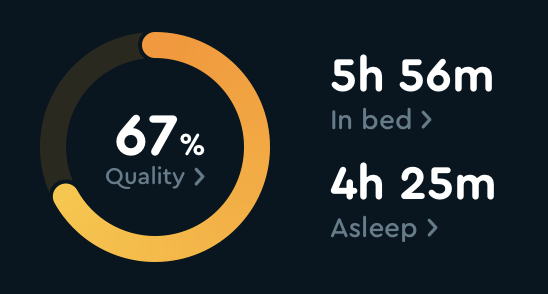
It was a struggle today. I only managed just over four hours’ sleep last night. I was up just very early this morning in order to fit my indoor bike trainer session in before an early work meeting.

I’m very surprised it was as high as 67%!

I’m very surprised it was as high as 67%!

I had planned to go to bed earlier, but we have a young teenager who has just moved into the ‘not tired at night’ phase and it doesn’t yet feel right to leave him to shut down the house while we ascend the wooden hill.

Due to the lockdown I am missing the hour of walking that used to be part of my daily commute to and from the office, so since March I’ve been prioritising exercise on most days. I enjoy exercise for its own sake, but it’s also motivating that there are numerous articles about how desk-based jobs are literally killing us:

Both the total volume of sedentary time and its accrual in prolonged, uninterrupted bouts are associated with all-cause mortality, suggesting that physical activity guidelines should target reducing and interrupting sedentary time to reduce risk for death.

But…other research says that lack of sleep may lead to Alzheimer’s disease in later life. I remember hearing how Margaret Thatcher got by on four hours’ sleep a night, making her the “best informed person in the room” according to her biographer; she suffered from dementia in her final years.

A wise man that once worked with me said “you can’t cheat the body”, and he’s right. But given the choice between exercising and sleeping, what’s the right balance to strike?

Are you still not going out?

Friends and family think I’m at best over-cautious, or at worst ridiculous. They don’t say it to me directly, but I sense it.

Most people I know seem to have returned to some kind of normality. Getting together indoors, going to pubs and restaurants, eating out, sharing trips in cars. These things crept back in gradually. People are fed up with keeping away from others and so badly want it all to be over. We stopped hearing about the people catching it, going to hospital with it, dying from it. It feels like the risks abated, and behaviour changed day by day.

Because I am not joining in, and continue to avoid any unnecessary face-to-face contact, I’m now very much an outlier. “Are you still not going out, Andrew?” “Life has to go on.”

I question my attitude all the time. I get drawn in. Perhaps I am being over-cautious, and need to get back to being social again. I’m certainly missing human contact and having any kind of a social life. But then I read a horror story about the long-term problems that some COVID survivors are trying to cope with, and it just reinforces my desire to keep away from everyone. It’s as if there is one version of events out there in the real world, and then people I know are gaslighting me.

COVID-19 has not been with us for very long, and every day there seems to be new stories about possible impacts on the human body, or new developments such as being able to catch the virus more than once. Even if the long-term impacts are mild, I am happy to make sacrifices to avoid them. From the New York Times:

“In meetings, “I can’t find words,” said Mr. Reagan, who has now taken a leave. “I feel like I sound like an idiot.””

I remember one December where I had to run a workshop after a big night out of festive drinking. My hangover manifested itself in that I was unable to string sentences together properly. Something had altered in my brain, albeit temporarily, and it was torture. As I spoke, it was as though I had a separate inner dialogue that was asking me “Where is this sentence going?”, and I didn’t know. The thought of being stuck like that permanently fills me with dread.

The film Awakenings (1990) with Robert De Niro and Robin Williams has always fascinated me. Based on a book by neurologist Oliver Sacks, it depicts people who had become victims of the encephalitis lethargica epidemic of the 1920s. From Wikipedia:

The disease attacks the brain, leaving some victims in a statue-like condition, speechless and motionless. Between 1915 and 1926, an epidemic of encephalitis lethargica spread around the world. Nearly five million people were affected, a third of whom died in the acute stages. Many of those who survived never returned to their pre-morbid vigour.

The book and/or the film draws a link between the influenza pandemic of 1918 and the subsequent encephalitis lethargica pandemic that followed. My understanding is that there is no irrefutable evidence that the first pandemic caused the second one, but this continues to be the subject of scientific debate.

Curious, I searched the web for “encephalitis lethargica” and “COVID” and found that (of course) I am not the only one to be thinking about this. Some examples:

US National Library of Medicine: From encephalitis lethargica to COVID-19: Is there another epidemic ahead?

The above characteristics can be indicative of the ability of coronaviruses to produce persistent neurological lesions. Acute COVID-19-related encephalitis, along with the potentially long-term worrying consequences of the disease, underscore the need for clinicians to pay attention to the suspected cases of encephalitis in this regard.

The Lancet:  COVID-19: can we learn from encephalitis lethargica?

We should take advantage of both historical and novel evidence. The prevalence of anosmia, combined with the neuroinvasive properties of coronaviruses, might support neuroinvasion by SARS-CoV-2. Whether the infection might trigger neurodegeneration, starting in the olfactory bulb, in predisposed patients is unknown. We should not underestimate the potential long-term neurological sequelae of this novel coronavirus.

NHS University College London Hospitals: Increase in delirium, rare brain inflammation and stroke linked to COVID-19

“We should be vigilant and look out for these complications in people who have had COVID-19. Whether we will see an epidemic on a large scale of brain damage linked to the pandemic – perhaps similar to the encephalitis lethargica outbreak in the 1920s and 1930s after the 1918 influenza pandemic – remains to be seen.”

The Conversation: How coronavirus affects the brain

Encephalitis and sleeping sickness had been linked to previous influenza outbreaks between the 1580s to 1890s. But the 20th-century epidemic of encephalitis lethargica started in 1915, before the influenza pandemic, and continued into the 1930s, so a direct link between the two has remained difficult to prove.

In those who died, postmortems revealed a pattern of inflammation in the seat of the brain (known as the brainstem). Some patients who had damage to areas of the brain involved in movement were locked in their bodies, unable to move for decades (post-encephalitic Parkinsonism), and were only “awakened” by treatment with L-Dopa (a chemical that naturally occurs in the body) by Oliver Sacks in the 1960s. It is too early to tell if we will see a similar outbreak associated with the COVID-19 pandemic, though early reports of encephalitis in COVID-19 have shown features similar to those in encephalitis lethargica.

The aftermath of this global event has many lessons for us now in the time of COVID-19. One, of course, is that we may see widespread brain damage following this viral pandemic.

I’m not sure when I’ll be at the stage where I feel comfortable visiting friends at their houses, sharing car journeys, or meeting up in pubs or restaurants. I doubt that there is a rigorous logical set of conditions that would need to be specifically met before I start doing those things again. I’ll know it when I feel it. Perhaps this stuff is just different for everyone based on their perception of risk versus their need to socialise to maintain a quality of life and good mental health. Perhaps part of it is that I am lucky to have a job that I can do from home so my need to venture out is minimal. Perhaps my interest in politics over the past few years has made me much more deeply distrustful of our government and their response to the pandemic than many other people. Eight months in, the novelty of being at home all the time has worn off, but I’m still ok to keep hunkering down for now.

Coronavirus anxiety

Although I’m now five months into new routines and a new way of life, I’ve been finding that my anxiety level has been creeping back up during the summer. The vast majority of my friends and family seem to have gone back to normal, pretty much giving up on social distancing. I feel that I want to shout out loud that there is still a pandemic on — the phrase that keeps coming back to me is the one uttered by Clark Griswold in the original National Lampoon’s Vacation when his family appeal to him to give up on their road trip to Wallyworld. “I think you’re all ****** in the head!” I understand the massive desire to get back to some kind of normality, I just don’t agree with taking the risks. I know that because of this, people think I am being ridiculous.

“You’re unlikely to get sick from it as you are relatively young and fit.” Yes, thankfully that’s true. But there’s a chance I could get it and be one of the unlucky ones for whom it has serious implications. The idea of having ‘long COVID’ doesn’t sound good either. And then, even if I caught it and had no symptoms at all, I could easily spread it to anyone else I come in contact with.

“I think it’s ok to sit in a restaurant as long as they have the windows open.” Yes, airflow reduces the risk, but why take the risk in the first place? Is it worth it? This is a highly contagious airborne virus; you need to take your mask off to eat, and you’ll be sitting close to your friends at the same table and potentially exposing yourself unnecessarily to the virus over a number of hours.

“There are lots of other things out there that you could get, or could happen, that could kill you.” That’s true, but there’s not many of those that we end up shutting down half of the world for because of the potential harm that they bring.

The more that people I know go back to normal, the less I want to see them, as I don’t trust that they have been careful in managing their own risk. I’m currently not prepared to sit in a restaurant indoors, visit my friends or family in their homes or have visitors to our house where they would spend their time inside. It has been difficult at times over the past few weeks where even those of us living under the same roof have had different opinions about the risks, but we’re managing our way through it.

Perhaps my anxiety partly comes from getting so wrapped up in following politics over the past half decade or so. I am deeply distrustful of our government and the people around them. I’m highly sceptical that they have our best interests at heart, or are competent enough to do a good job even if they did. Managing a pandemic at a government level must be unimaginably complex, and our collection of ministers are second-rate at best. I know that I have to take complete personal responsibility for myself.

“Look at the case numbers in the UK though, they are flat.” That’s been true for the past few weeks, but they are on the rise again. Have we ever had a good test and trace regime that we can rely on here in the UK? Would the government tell us the truth if the numbers were not good? We know that there is probably a two-week lag time between exposure and developing symptoms or becoming contagious yourself, so who knows how many cases are really out there.

I am in an extremely privileged and fortunate position of having a very caring employer who has allowed us to work from home since mid-March. We are unlikely to be asked to go back to the office any time soon. I know that for a lot of people things haven’t stopped or changed during this whole pandemic — they have had to get out to work, my wife included — and I am in awe of them. I also understand that we are social creatures and there is a need for us to meet and connect with each other. I just don’t understand why people would take unnecessary risks such as dining in restaurants with friends or meeting in each other’s houses when there’s no need to.

This weekend my wife and I took a rare walk into town together to buy a coffee. As soon as we got anywhere near other people I put my mask on and didn’t take it off until we were almost home, well clear of everyone else. Maciej Ceglowski’s post from back in April, called Let’s All Wear A Mask, is the kind of logical argument that speaks to me as he outlines his case brilliantly. But it’s clear from my stroll around town that masks are generally seen as an inconvenience and only worn for going into shops, if at all.

I am trying to check and question myself. Sometimes I feel like I’m probably the one in the wrong as everyone else seems to be taking it easy with a relaxed attitude to the risks, but then I just work through the logic again and find myself right back at the start.

Difficult decisions

For the past two days we’ve had major debates in our house about whether our children should be in school. I’m now working from home, and am certainly not planning on being out of the house much. Our soon-to-be 13-year-old made some very reasoned arguments this morning about why he shouldn’t go. I tend to agree with him. As he gets older I’m less sure of myself in terms of how much control we should have over his life. I’d never let him stay home from school on a regular day, but what’s happening in the world right now is so irregular that I’m not sure the old rules apply.

From The Guardian: How do coronavirus containment measures vary across Europe? — 16 March 2020

From The Guardian: How do coronavirus containment measures vary across Europe? — 16 March 2020

Despite the almost all of the rest of Europe deciding to keep their children at home, the UK has decided not to. I am deeply distrustful of the government, but I can see the reasoning as to why they would be kept open:
– Parents who are unable to work from home may need to ask elderly relatives to look after the children
– We have vulnerable children across the country who rely on free school meals to keep them nourished
– Schools aren’t really set up for teaching via remote means.
For our family, we are fortunate enough where only the last point impacts us.

It’s still not a slam-dunk. My wife works as a teaching assistant in a primary school and she is providing a valuable service to society by continuing to go, for all the reasons above. (She is amazing.) I’m a Vice-Chair of Governors at another primary school; we have to rely on advice from government, Public Health England and others on what to do, and my role is to support the school in this. We also have a friend who works as a Paediatric Matron at a local NHS hospital, and she is still sending her children to school — if she felt that the risk was significant, she would keep them at home.

It’s a tricky one with no easy answers, and I am sure that there are so many people going through similar dilemmas right now.

A year of being sober

I turn 41 today. This also marks the end of the first year since I was a teenager where I haven’t had any alcoholic drinks.

Alcohol has always been a big part of family life. The British are well-known for drinking and this has been no different in my family. My lovely mum spent her formative years growing up in a pub and was living there when she met my dad. I remember many a Sunday visit to see my grandparents on my dad’s side where we spent time down the Royal British Legion, clutching my crisps and lemonade whilst being mesmerised by my dad’s pint of lager, watching the bubbles form from their little invisible factories, expand, reach critical mass and rise to the top. My parents both have lots of siblings and everyone has always loved a big family party, so my childhood memories are filled with tables of buffet food and well-stocked drinks tables for everyone to help themselves to. One of my uncles even had a brick-built corner bar in his lounge, Del-Boy style, and I fondly remember one event where I was given the job of manning this bar, serving drinks to everyone all night long. I thought it was brilliant.

When I was a young teenager, I read somewhere that alcohol destroys brain cells so I decided at that point that I was going to abstain. This decision resulted in regular ribbing and ridicule from my aunts every time we got together. Of course, my sobriety didn’t hold out forever. I probably started drinking regularly when I was 17 or so along with a lot of my friends. It felt grown up, it was what everyone was doing and it was fun. Hilarity, hurling and hangovers ensued, with the first outweighing the other two for the most part.

From the start, I was never consistently great at holding my drink. My personality was such that I tended to get louder, more overbearing and sweary the more I drank, sometimes to a point where all the energy I exuded would collapse back in on itself and I would fall asleep.

Over the next couple of years I started drinking with my friends on a regular basis. I love strong tastes and quickly moved from lager to real ale as well as red wine. On my first day at university I instigated an early visit to the Students’ Union, playing pool and taking advantage of the low prices in the Union bar all afternoon.

At first I couldn’t recognise when drinking became a problem. At uni I felt that everyone around me were managing to get all of their work done whilst still going out and partying most evenings and therefore I should be able to as well. I couldn’t recognise that it wasn’t doing me any good. I wasn’t eating well, was in a destructive relationship and was getting paranoid. Drinking was now a big part of my life, but if viewed from the outside the choices I was making wouldn’t have looked any different to that of any other university student and I don’t think anyone was worried about me. Things came to a head in my relationship and I ended up seeking help for depression. Nobody said anything about drinking but in a moment of clarity I realised that even though alcohol wasn’t the root cause, it was another obstacle to getting myself sorted out, so I decided to a break from it completely. Six months of no drinking felt like a long time, but I also knew I was looking after myself and it was a big help to be clear-headed as I slowly found my feet again.

After that, drinking slowly crept back into my life. It wasn’t a problem per se. For the most part I had learned to pace things a little better and was strong-willed enough to say “no” when on a night out someone decided to get in a round of shots even though they might persistently cajole me to join in. For the next 15 years I followed a pattern of drinking a little, then increasing amounts over the next few days/weeks/months until eventually I would be drinking every night or have a big night out where something would happen such as saying the wrong thing to someone, having an argument, vomiting or waking up the next day and forgetting all of the details of an important conversation with a friend etc. I would then ‘put the brakes on’ and the cycle would start all over again.

In December 2014 we were invited to a friends’ house for a Christmas meal along with a number of other families that we hadn’t previously met. Dinner was excellent and the wine was flowing; I spent a lot of time laughing with one of the guests while we worked our way through a bottle of vintage port. At some point later in the evening I remember filling some of the silences (which might not have even been there in the first place) with making jokes at someone else’s expense — someone who wasn’t at the dinner and whom I barely knew. Around 3am I started to get droopy-eyed and was encouraged by the hosts to have a coffee and a walk around their vast garden so that I could come back in and carry on drinking. I got to bed at 4am … and the kids woke up at 6am. As I stood in the kitchen my pounding heart would not stop racing and felt as though it was going to pop out of my chest. Somehow my wife and I had to hold it together and get through to the kids’ bedtime that evening. Later that day I took my five-year-old out to the fields behind our house with a camera on the pretence that he could photograph some wildlife when in actual fact I was trying to get some fresh air and feel a little less horrendous. I kept recalling and wincing at things I had said the day before and was filled with regret; this wasn’t the person that I wanted to be.

At work the following day I could still feel the effects, mainly in finding it very difficult to string together sentences in my speech — not great when you are running an important programme and chairing a workshop with twenty people in the room. I decided there and then that I had to stop drinking for a bit. Again. I told myself that this wasn’t forever, it was just for a while. We were a week or two away from Christmas but I felt that this was as good a time as any; giving up early in December meant that I could avoid all of the stress around deciding which of the zillions of parties and social functions I would drink at whilst trying to still be great at my job, being a good dad, a good school governor etc. Deciding to not drink suddenly untangled the weeks ahead and made everything much more simple. At first, saying no to alcohol at dinners and events felt a bit awkward but I soon found a familiar pattern of getting through the first hour of curiosity and questioning before people started to get tipsy all around me and they became more interested in something else.

2015 — new year, new start. In the first week of January I signed up for both the London Revolution and Ride 999 long-distance cycling events. Training for these gave me the perfect excuse to continue my sobriety. In truth, whenever I went out on my bike I kept recalling the St John Ambulance First Aid at Work course I’d attended the previous month where the trainer had said that heart attacks are statistically much more likely the day after a drinking session. Given that I needed to get fit and had lots of training rides to get up early for I didn’t think that drinking would be a good idea. I felt very happy and content about the lifestyle choice I had made — right up until a few days into Ride 999 in June, where all the riders finished off each day with a lovely cold lager and my alcohol-free alternatives didn’t seem to cut it. I joined the team for the odd beer and by the time July and August rolled around I was back into my old routines.

Throughout 2015 and 2016 I had been feeling more and more as though alcohol was something I would give up eventually. I was just a whole lot happier when I had decided not to drink. I started looking for positive reinforcement and found articles, books and other resources that helped clarify my thinking. (Yes, I know this is confirmation bias!) Friends and relatives had also had time off in the past ranging from a month (the famous ‘dry January’) to six, and every single time they have said to me that they were happier and healthier when they did it. If everyone who has tried it knows it, why do we keep going back? I think that the social norms around alcohol are so strong that even though people realise they are more content when not drinking it is very easy to get pulled back into having one or two. And then, why stop there?

I knew that I wasn’t an alcoholic as I had easily given up or abstained many times in the past. It was more a question of mental commitment to what I wanted to do for the long term. Could I really give it up completely, forever? What about all of the great ‘special’ bottles of champagne, port etc. we had accumulated in the house? Would I miss out on them?

I kept thinking about my children and the interest they were taking in what the adults did, asking me questions about different types of alcohol. I thought back to my school days before I started drinking regularly — wasn’t I happy enough then without it? If so, why is it different when you’re an adult?

Some of my close friends and family had said that the best thing to do would be to live a lifestyle where I ‘just have one or two’. I had tried this many times before and it hadn’t worked out; I had always fallen back into the habit of ramping it up over time. This passage in The Sober Revolution really helped me in knowing that I wasn’t the only one who found moderation difficult:

“for a multitude of reasons people often toy with the notion that they can terminate their problematic drinking behaviour by simply imposing a few rules here and there and without actually committing to full time sobriety. In my experience, these efforts to control or moderate alcohol consumption do not work for people who have persistently displayed an inability to drink within reasonable limits.”

As we headed towards New Year’s Eve 2016, and my 40th birthday, I felt ever more strongly that the best present I could give myself would be to give up drinking completely. My friends hosted a brilliant party, but getting drunk on New Year’s Eve felt a little bit like going through the motions for the final time. It served as a useful reminder of one of the reasons I didn’t want to do it anymore; my seven-year-old boy wasn’t feeling too well and instead of looking after him I had left my wife to it while I selfishly indulged and danced the night away. I knew that even though I barely ever drank to excess anymore it was still taking more away from me than I was getting out of it, and it was time to stop.

“If one embarks on alcohol-free living with the deep-seated belief that they’ve given up something of worth then they are heading for a resounding fall from the wagon. To conquer alcohol-dependency, it is crucial never to consider one’s self to be ‘on the wagon’ in the first place; this expression is loaded with connotations of temporariness, a short-term quiescence from normal life. In order to walk away from booze for good, it is essential that upon reaching this incredibly positive and empowering decision, you recognise that it is a step which will lead you to great things, the beginning of an exciting adventure and a whole new way of life.”

Positive and empowering. This is exactly how it felt on New Year’s Day when I knew in my head that I was done with it completely. This year I have felt a lot like when I decided to stop eating meat nearly 20 years ago. One day I just decided that it wasn’t something that I did anymore. Once I had accepted it, really accepted it, everything else has been unbelievably easy. I am no longer clinging onto the ‘special’ bottles of champagne and other fancy drinks in our house and am happy to give them away to people who will enjoy them. They are of no use and have no value to me.

This year has been brilliant. Through the various nights out, including a weekend away in a big country house with all my close school friends to celebrate us all turning 40, I have realised that any ‘need’ to have a drink is a complete illusion. I have been able to have a laugh as well as being able to read a bit when I get into bed (and remember what I read!), have a good night’s sleep and be hangover-free the next day. Drinking adds nothing to who I am. My two young boys are aware that I don’t drink anymore and talking to them about alcohol and drugs no longer feels hypocritical. I’m more productive, less grumpy and a better dad and husband. There is no hardship or martyrdom, I’m just happier, and won’t be going back this time.

Something is wrong on the internet

This article by James Bridle is being shared everywhere and for good reason. I’ve seen first hand one of my children wandering to a seemingly innocent YouTube video called something like ‘Try not to laugh’ which interspersed cartoon sequences with video of real bus crashes and a death metal soundtrack. The deliberate shock material the most upsetting thing to me, although the weird farms of auto-generated CGI videos that are then being watched by robots in order to generate income from the advertisements is pretty disturbing. I assume that Google doesn’t mind too much as they take their cut of the advertising revenue. Just think of the external impact of the energy resource usage that is going into this.

My mind is blown by how quickly there is a grotesque race to the bottom as soon as a new technology platform is introduced. YouTube’s launch in 2005 feels like yesterday and here we are already.

A little respect

Raiders tournament, June 2017

Berkhamsted Raiders tournament, June 2017

A couple of weekends ago I spent an entire Sunday sitting in a field watching my two young boys competing in the Berkhamsted Raiders football tournament which traditionally marks the end of our season. Raiders is a great club to be a part of — we have won FA and European recognition for the club, and particularly how it is run in the spirit of respect and fair play.

If you turn up at a match at our club you will always find someone has put up a ‘respect barrier’ rope along one of the lengths of the pitch, the idea being that the supporters from both teams stand behind this to watch the match. This gives the players, coaches and referee a bit of distance — a brilliant idea, particularly when the match is getting heated and temperatures are running high. It’s always the job of the home team to get the respect barrier up before the game. If the person putting it up has managed to untangle the rope and get the support poles into the frozen ground, an aerial view of it would look like this:

Typically when the supporters turn up they cluster at each end with people that they know. Here they are, eight supporters of each team closely watching the ball which is dangerously close to the goal on the left:

The problem with this setup, especially when the ball is close to the line near the respect barrier, is that not everyone can see. If the action is directly in front of you it’s fine but if you are at the other end of the pitch or even a few people deep, the angle to the ball means it becomes very hard to maintain a clear line of sight. Everyone is straining to see which only makes the situation worse:

Ladies and gentlemen, there is a solution to this problem! I’d love to take credit for it but it has to go to a fellow parent from another Raiders team who suggested it to me. Instead of having the respect barrier completely parallel to the length of the pitch, it can be configured in a ‘V’ shape as shown below:

Assuming that people don’t push so far forward that they strain or break the respect barrier (showing very little respect in the process), everyone at the front should then have a reasonable chance of seeing the action wherever it is on the pitch. Occasionally this can be difficult to do where one pitch sits alongside another one, however the ‘V’ doesn’t have to be very deep in order to have a massive impact on visibility:

Hopefully, armed with this knowledge we’ll be able to go into next season being able see even more on-pitch action than before. Well, at least at our home games.

Raising confident, competent children

My employer has recently signed up to the CityMothers network which gives staff the opportunity to network with other working parents and attend seminars and events organised by the group. Yesterday morning I went along to my first one, hosted at the law firm Bird & Bird, on ‘Raising Confident, Competent Children.’

The presenter, Anita Cleare, was excellent. I gathered from the comments of other attendees that some had been to her seminars a few times before; lots of them had very glowing feedback about her presentations and a few mentioned that they had taken action based on her advice which had changed their home lives for the better.

The seminar was good in that it reinforced to me that my wife and I are already doing—I think—a reasonably good job with our children. Time will tell! However there were also a few tips that I picked up as well as some tweaks that I think we need to make in terms of how we deal with certain situations.

The session was divided into six subject areas and here are my notes from each one:

Encouraging cooperation

  • If you need your child to do something and have a request of them, use the following process:
    • Get close to them
      • Makes you more difficult to ignore
      • Means that you do not need to raise your voice
    • Use your child’s name
    • Give a clear instruction—don’t be ambiguous
    • Pause for at least five seconds
    • Praise them if they do as you ask
    • Repeat once if necessary—don’t ask more than twice, otherwise you are giving a signal that it is okay to ignore you
    • If you are ignored twice, back up the instruction with a suitable consequence.
      • This will be difficult at first
      • Make sure you keep calm and do not shout
  • This is all about getting into a habit of listening and doing what is asked the first or second time

Being considerate

  • Children are unable to truly empathise when they are young—they are unlikely to truly empathise until they are much older—however they can learn the behaviours of kindness
    • Listening
    • Taking turns
    • Ask what others would like to do
    • Etc.
  • As a parent you need to model good behaviour for your children
    • Avoid criticising others
    • Point out others’ good points
    • Praise your child for being helpful
    • Ask your child about feelings
    • Encourage your child to make amends
    • Provide a consequence for inconsiderate or hurtful behaviour

Social skills

  • Encourage friendship
  • Expect appropriate behaviour from your child and from visitors
  • There was a tip from someone in the audience where she is part of a group that take it in turns to have random Friday off and have the kids over in a group. “This is a lot easier now the children are older.

Having healthy self-esteem

  • There is a self-reinforcing cycle about having or not having self esteem. If children don’t have it they will exhibit behaviours such as giving up on things easily, not making friends etc.
  • Things that are related to positive self-esteem in children:
    • Thinking and believing good things about themselves
    • Receiving lots of praise, affection and attention from parents
    • Having achievements recognised
    • Having clear limits and appropriate discipline
  • An example was given about a child who comes off of a football pitch and says “I had a rubbish match, I played terribly.”
    • Don’t contradict this, especially with an untruth such as “No, you played great!” Instead, help them interpret this and think about what they would do differently next time.
    • What they said was perfectly reasonable as long as they are not globalising and catastrophising it such as “I don’t like football, I’m rubbish at all sports.”
    • Try to help them to look at what happened objectively and avoid negative thinking.
  • Someone in the audience raised a point that their elder child says to their younger child that they are better than them at something and this makes it hard for the younger child to gain or keep self-esteem.
    • Again, don’t contradict this if it is true—don’t say “no you’re not!”
    • Instead, try to help interpret why this is (“he’s two years older than you”) and look towards the future (“when you’re grown up you may be better than him at that.”)
  • Encourage your child to set goals and work towards them.

Problem-solving steps

  • Children need to be guided through the process of problem solving, i.e.:
    • Define the problem
    • Come up with solutions
    • Evaluate the options
    • Decide on the best solution
    • Put the plan into action
    • Review how it worked and revise the plan if necessary
  • How to help them do this
    • Set a good example and model doing it yourself
    • Play games that promote thinking
    • Encourage your child to find answers
    • Prompt your child to work at solving problems
    • Congratulate your child when they solve a problem on their own
    • Involve your child in family problem-solving, e.g. “What do we think we can do so that we aren’t shouting at each other to get out of the door every morning?”

Becoming independent

  • If you’re a working parent, don’t compensate for your absence by running around and doing everything for them when you are at home—you’re not helping anybody in the long term
  • Give the children simple jobs to do
  • Know they won’t be able to do them very well at the start but they will get better
  • You need to teach and show them how to do it or they won’t do it
  • Examples (for my family) are making their own beds, putting dirty clothes in the wash basket, tidying up, feeding the cats, putting things in the dishwasher
  • Families live in houses and families need to take responsibilities for the things that happen there, not just the grown-ups
  • Children doing jobs will create more quality time for you as a family!
  • Morning traps
    • Getting up late
    • Rushing
    • Not being organised
    • Taking over and doing everything for your child
    • Giving too many prompts and reminders
    • Can be all about priorities and power. Align the priorities and hand over power. Structure it so that if these things are done they can play or have a reward. Ramp it up gently—if there are five things to do then the first day reward them if they do one thing on their own!
    • Someone in the audience says this has been amazing for her family life—her child has to be at the door ready by 8:15am and then gets to use the tablet in the evening.
    • Suggestion from someone of having a stopwatch to see how fast they can get ready for school
  • Have a set time for homework

It was definitely worthwhile and good to have some time to reflect on how we do things in our house. The view from the office was pretty fantastic too:

The Art of the Brick

We took a family trip to London today to go and see The Art of the Brick exhibition in the Old Truman Brewery near Spitalfields. Our boys (aged seven and five) both enjoyed it and we wandered around to a lot of excited calls of “Daddy!” and “Mummy!” as they came across new things.

Although a lot of the artefacts in the exhibition were impressive, the notes about each exhibit came across as pretty cheesy and at £47 for all of us to get in it didn’t feel like great value for money. Still, we had fun and enjoyed a look around the market afterwards. Photos from the exhibition are below.

[simple-flickr set=72157648671375860]

Children and technology

At bedtime tonight my two boys spent 20 minutes walking me through their Minecraft book and excitedly telling me me all about the worlds they have created, the things you can build and the characters you can encounter. They’ve been reaching for the iOS version of the game at every opportunity we give them. As much as I enjoyed talking to them about it I always feel so paralysed and conflicted about the children and technology. Half of me wants to just embrace getting computers, Raspberry Pis etc. to encourage them and the other half of me is scared of losing them to computer and video game addiction and/or the perils of the Internet.

It feels weird that the adults in the house have pretty much unrestricted use of technology and the kids just have a little bit of time playing games. When I was little in the mid-80s to mid-90s it was the other way around—I spent endless hours on the computer and it eventually led me to a Computer Science degree and a career in technology—but those times were different. With my old Acorn Electron, BBC Micro or A3000 I was limited to playing around with the programs I had on disk, typing in ‘listings’ that were printed in magazines or writing programs of my own. I know a bit of the answer is to sit with them in order to make sure the time is spent well but this isn’t always practical and a big part of me wants them to spend time exploring and creating on their own without me supervising their every move. They should soon be showing me things that I didn’t know! By restricting their interactions with technology could they be missing out on possibilities to learn and grow?

I’ve toyed with the idea of buying a refurbished pre-Internet computer and showing them how to program it but if it doesn’t spark their imagination it would be a bit of an expensive mistake. They talk about their friends having consoles but I’m not sure I want an XBox or PlayStation in the house due to not having time myself to understand how to make them safe for the children. We can restrict the games to family-friendly ones but I assume they come with lots of social features and I’d like to turn some of those off until they are a bit older.

I realise as I type this that these are all ‘first world problems’ and in the grand scheme of things this isn’t a big deal but it continues to play on my mind as they get older. I’m sure we’ll work it out.

Doughnut

I’m a doughnut. Last night, for the second time, I bought my wife some flowers from the lovely flower stall at Euston station and left them on the parcel rack on the train. Hopefully someone gave them a good home! Ever feel like it’s not your week?