
A tough week. Last weekend, for no reason whatsoever, the cloudy, grey feelings descended on me as they have occasionally done since I was a teenager. When it happens, everything gets tinged with sadness and negativity, without any cause. It’s hard to find the joy in anything and you just want to go back to bed. I end up feeling really tired despite having had a good night’s sleep. My wife knew I was in a funk. It doesn’t happen very often, but when it does, I know it will pass. I just have to be kind to myself until it does. I carried it all the way through Monday, but it started to dissipate as the week went on. Brains are bizarre.
This was a week in which I:
- Had several meetings with our Digital Insights team in South Africa to discuss how we can work together to investigate business opportunities.
- Discussed our approach to phishing training across the organisation, and how it fits into the broader context of mandatory training for all staff.
- Met with a project manager in my team to talk about how we might build a roadmap for our work. I love a simple but insightful question such as “Why do we want to do it?” as it brings clarity.
- Finally completed a long email to a COO of one of our business functions, highlighting a pain point, and suggesting both a tactical next step as well as longer-term strategic changes. I’ve been thinking about some of the points for years, and it felt great to finally get it out there. A response from one of his colleagues showed that my note was taken in the constructive spirit that it was intended. Hopefully it will come to some good.
- Enjoyed a lunch laid on for the office, followed by a talk about our strategy from our regional CEO.
- Booked into sessions for the Gartner CIO Leadership Forum in March.
- Had an introductory meeting with the CEO of our largest technology supplier, after his firm completed the acquisition of the company that we have worked with for many years.
- Joined the weekly project meeting for our sister company’s office refurbishment initiative.
- Rewrote and rebranded the office-wide communications for the reopening of the refurbished basement facilities in our building.
- Had a catch-up with my People & Culture Business Partner on a bunch of ongoing topics relevant to my team.
- Interviewed another candidate for our software developer role.
- Met with my boss and my Executive Partner at our technology consultancy and advisory firm for a discussion about my career. I am very fortunate to have such good people who want to give their input and guidance to me.
- Had the monthly formal meeting of our Diversity, Equity and Inclusion forum.
- Had our annual meeting with our financial adviser. All of our discussions and planning have been focused on the assumption that I will retire at 67, but with various people calling time around me, I started to ponder whether this is really how it will play out.
- Felt very proud of our eldest son, who broke his college’s mile record at a race meet in Houston, Texas.
- Took my son’s bike into our local shop for a service ahead of his planned big cycling adventure with his friends. It needed two new disc rotors, a new left-hand brake/gear lever and a new headset bearing. So, it was well worth the visit. Hopefully it will stop raining soon, so he can take it out for an enjoyable test ride.
- Bought and set up a new laptop for my wife, as her old one was fraying at the seams and out of support after nine years of active service. Being the home IT admin guy is great, but this stuff can take up so much time.
- Reviewed the detailed lease documents for my wife’s parents’ new house ahead of their upcoming move.
- Enjoyed using some vouchers for a Sunday night dinner at Pizza Express with the three-quarters of the family currently in the UK.
- Left my umbrella on the train, paying my regular idiot tax. I was on such a good run of form too. Amazon tells me that the latest one had lasted about 17 months, and my replacement will be the fourth of this particular model. There must be a big pile of umbrellas somewhere, in my case either at Milton Keynes or London Euston. What happens to them after that? I’m wondering whether in the future it’s actually OK to take an umbrella that seems to have no owner, as this completes the cycle?

- Made some tweaks to my blog, moving over to Libre Franklin as a consistent typeface, reducing aggressive hyphenation at the end of each line, and making a small change to the CSS for related posts. Claude helped me immensely with guidance on how to do both. I also cleaned up the categories on a couple of posts that caused some weird rendering issues on the Archive page, as well as deleting some very old posts that frankly were just a bit embarrassing two decades on. Posting things in the early days of blogging, prior to modern social media, when the only people that read what I wrote were my immediate friends, is very different to now. I’m in good company in doing this.
- Started paying for Claude as I wanted to get my hands on the web-based version of Claude Code. Within 45 minutes, despite barely knowing what I was doing, I got it to implement my first change, a small tweak to the code for the WB-40 Album Club site. This was an obvious place to start as it is a project I host on GitHub, which Claude Code interfaces with directly. I went to bed on Sunday night with my head racing with thoughts of how I might experiment with it.
Media
Podcasts
- After a tumultuous few days for the UK Prime Minister in relation to the fallout of the Epstein Files, Alastair Campbell’s thoughts were an interesting but far from optimistic way to start the week.
- The deconstruction of Prince’s Kiss on Strong Songs is superb. I’ve always thought it to be such a unique-sounding record, particularly for the time it came out. Kirk Hamilton breaks down exactly why, and also reveals that it’s actually a blues track.
- Nigel Farage, leader of Reform UK, has been railing against people working from home. The absolute brass neck of the man. On Quiet Riot, Alex Andreou breaks down Farage’s voting record in the House of Commons, a place that he is meant to attend as his place of work to represent the people of Clacton:
Alex Andreou: So since being elected, Nigel Farage has voted 162 times. Now, let’s compare that, for instance, to Richard Tice, who has voted 235 times. So that’s quite a significant 30% more than Nigel Farage. And we’re looking at someone who was elected at the same time for the same party.
Naomi Smith: And lives in Dubai.
[…]
AA: Miatta Fahnbulleh, friend of the podcast, 306 times. And she’s a junior minister. They often get paired and often have a legitimate excuse not to go to votes that are not particularly controversial, I guess.
Sian Berry, elected at the same time, party of a similar size to Reform, she has voted 336 times. And that is elegantly just over twice the times that Nigel Farage has voted.
So we can look at that and we can look at his record as an MEP. In 2019, when Byline researched attendance and amendment contributions, out of 751 MEPs from 28 countries, Farage’s record was the third worst of everyone, and joint worst having made zero amendment proposals. So he contributed nothing to any legislation and only showed up just over half the time.
NS: Yet pocketed the pension.
AA: So on that, I would agree with him. There are some professions which require you to be present. And being a member of Parliament, Mr Farage, is one of them.
- Over the weekend I wrote about Matt Shumer’s post that “something big is happening”, and how I don’t understand the big-picture end goal that the AI companies are ultimately pursuing. It made me smile to hear the hosts of the Sharp Tech podcast talk about how Mark Zuckerberg plans to spend $135bn — Meta’s entire free cash flow — on AI capital investment, but effectively admitted on an investor call that he can’t say what the return is. I guess time will tell whether this is genius or madness.
Articles
- A Mastodon thread from Jurgis Kirsakmens on how LLM AI coding agents are not good for mental health.
- Along these same lines, Simon Willison covers a Harvard Business Review paper by Aruna Ranganathan and Xingqi Maggie Ye on how “AI Doesn’t Reduce Work — It Intensifies It”:
I’m frequently finding myself with work on two or three projects running parallel. I can get so much done, but after just an hour or two my mental energy for the day feels almost entirely depleted.
I’ve had conversations with people recently who are losing sleep because they’re finding building yet another feature with “just one more prompt” irresistible.
The HBR piece calls for organizations to build an “AI practice” that structures how AI is used to help avoid burnout and counter effects that “make it harder for organizations to distinguish genuine productivity gains from unsustainable intensity”.
- Reading Baldur Bjarnason’s book The Intelligence Illusion a couple of years ago was incredibly helpful for me as I got my head around the world of generative AI. This week he reflects on whether his views have hardened since then. I agree that it’s not that the tools aren’t useful in specific cases, it’s that they are applied in terrible ways:
Personally, my personal conclusion was that the only usable tool to come out of this all are the speech recognition and transcription models. They aren’t great, you need to edit the output a lot to make it usable, but they reduce the work of transcribing audio by a substantial margin as long as you don’t use OpenAI’s Whisper. OpenAI’s model fabricates in its transcripts. To this day, it still regularly makes shit up in its transcripts. That it’s being adopted in healthcare around the world should terrify you. That it’s being sold into these sensitive industries by OpenAI even though they seem well-aware of these flaws should make you question the integrity of the people running that company.
[…]
I never had high expectations of this industry, but it still managed to disappoint me.
- Nolan Lawson wrote a sad but pragmatic piece about mourning the craft of software development.
- An interesting article by Maria Rosala about “How AI Literacy Shapes GenAI Use”:
You might expect that users with a stronger technical understanding of AI would be open to using AI for various tasks, including personal information seeking. This pattern generally holds in tech: Those who understand how a technology works tend to adopt it more. However, research published in the Journal of Marketing found the opposite: lower AI conceptual knowledge predicted higher receptivity to using AI. This counterintuitive finding was replicated across 6 studies with diverse samples, from undergraduates to a nationally representative U.S. sample. Even after controlling for numerous conditions, such as general tech attitudes, general knowledge levels, and beliefs about AI’s capabilities, lower AI conceptual knowledge still correlated with greater receptivity.
The authors found that a sense of awe helped explain the trend: users with lower conceptual knowledge were more likely to see AI as “magical.”
This finding illustrates why adoption (and even enthusiasm) is not a reliable indicator of critical evaluation skill.
- A friend shared this article on how “AI isn’t replacing radiologists”. It’s a useful sense-check after reading Matt Shumer’s post on how AI is coming for everything. If AI makes things more efficient, perhaps that will help with getting waiting times down in our National Health Service?
- David Allen Green writes with typical clarity on “The constitutional significance of what happened to the Prime Minister last week”. Reading this gives me hope that our constitution in the UK is sound, and that it will remain so in the event of someone like Nigel Farage (or worse) ending up as Prime Minister.
- In the context of the appointment of Peter Mandelson as UK Ambassador to Washington DC, the revelations in the Epstein files, and the subsequent mess that Keir Starmer finds himself in, Arthur Snell breaks down how the vetting process for these senior civil service roles actually works. It’s shocking reading.
- Ben Werdmuller wrote an important note about personal security after he joined a public Signal group with his full name visible.
- I enjoyed this post about having ‘too many’ interests, which has always felt like the perennial problem of my life.
Video
- Dipped into more of the Winter Olympics, including figure skating, and the Snowboard Cross Mixed Team where we were shouting at the television from our seats as Team GB won gold.
- Colin Hoad’s video about the gold-plated BBC Micro in the Science Museum is excellent. I used to own a copy of the edition of The Micro User magazine where they gave this away as a prize. It has a slightly mysterious journey from 1985 to now, but it’s brilliant that it is now displayed in public for people to enjoy.
Audio
- Enjoyed Album Club #180 where we listened to Sugarcoat by Blushing, a band whose name does not seem to stick in my head no matter how hard I try.
Books
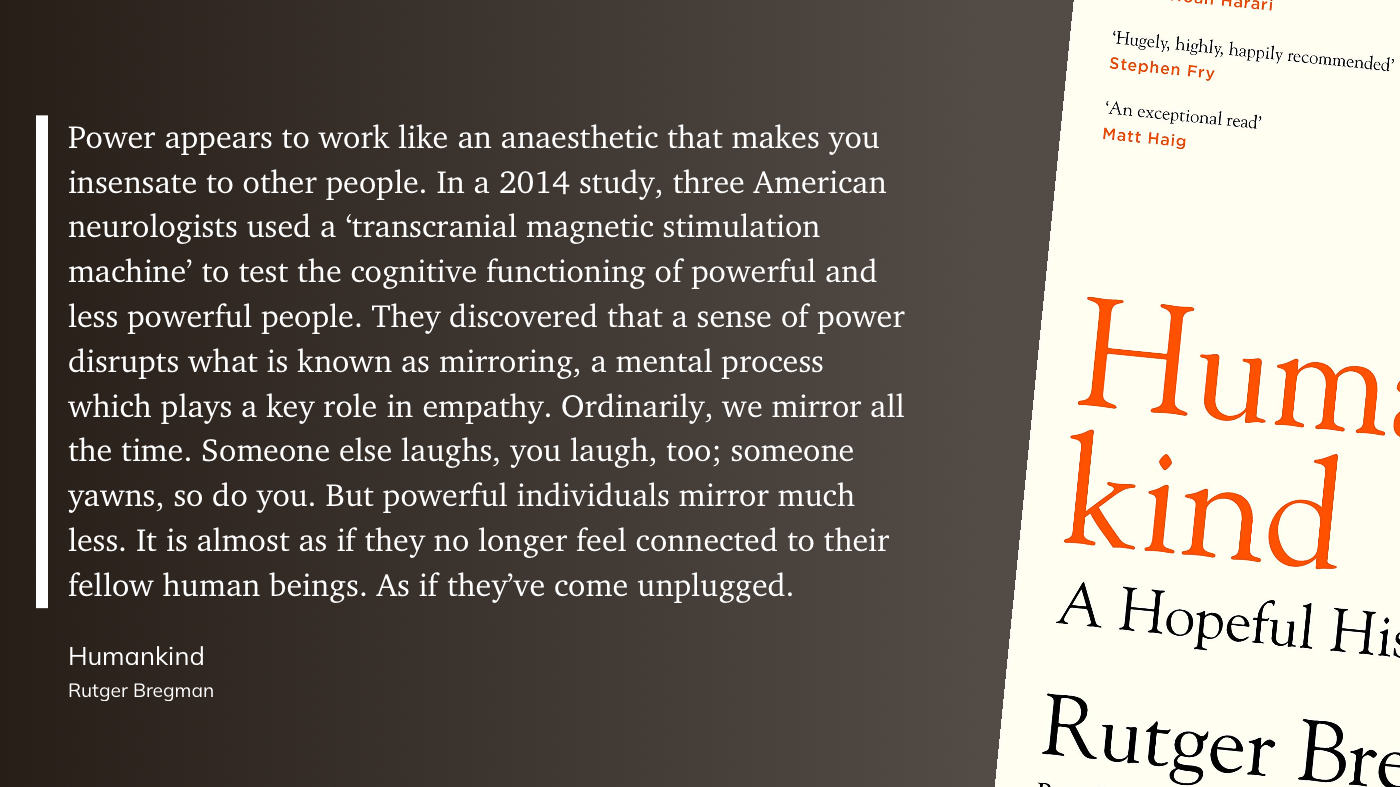
- I’m about halfway through Humankind: A Hopeful History by Rutger Bregman. My reading feels very distracted at the moment as I have been lured into explorations of blog posts. Picking up a book is a soothing balm for a busy brain.
Next week: Another trip to the cinema, this time to see the new Paul McCartney film.
Leave a comment