
A productive, balanced and enjoyable week.
This was a week in which I:
- Spent time reading through our business strategy documentation and trying to learn about global capital flows. I’ve been asked to pick up some additional projects that sit outside Technology. Despite 26 years of working in investment banks, there is so much I still need to learn. The team are going to need to be very patient with me as I ask lots of basic questions. But maybe that’s part of the point of getting me involved in the first place.
- Attended a pilot of an internal ‘prompt engineering masterclass’.
- The content and the delivery were good, but it got me pondering how on the one hand AI is marketed as being magic — you tell it what you want and sit back in wonder as it does the rest — and on the other hand we’re loading people up with lots of detail on how to structure their inputs to get it to do what they want. I suggested that perhaps there is another way to guide people on the path, e.g. saying “You’ve already been doing things with Copilot and other AI tools, here are some ways in which to improve the quality of the output you get from the machine. You don’t need to remember all of this, but you can draw on aspects of it as you work, and gradually integrate this into what you do.”
- A synonym for ‘prompt engineering’ is ‘learning to write clearly and formulate insightful questions’. In many ways, the skills for prompt engineering are the same as requirements engineering, which the software industry has been working on for decades. Andrew Stellman recently articulated this brilliantly.
- Even people experienced with generative AI still fall into the trap of misunderstanding that the output of an LLM is “the most probable output for the input prompt.” At the end of the session, someone showed us how they built a pre-prompt into Copilot to always get it to explain what it will do before it does it. It cannot do this. Instead, it will give you an outline that is a reasonable response to the question. It is like someone asking how I’ll do a project: I’ll say I’ll do A, then B, then C — and then, when I execute, I do something else. For me, it is so critical that we get people to understand this. The systems are designed to make you fall into a trap of thinking they are more ‘intelligent’ than they are in reality.
- I wondered whether the tools have already started to move on, de-emphasising the need for ‘prompt engineering’. The most success I have had in dialling down hallucinations and improving accuracy has been to use the ‘Thinking’ mode in ChatGPT and, where appropriate, the Deep Research tool which is now also available as a default Copilot Agent. These take orders of magnitude longer to return results, but the outputs are much higher quality. Giving people guidance as to when to use the ‘quick’ responses and when to use the ‘extended thinking’ tools would be very useful.
- Had a long discussion about a planned IT security change that was both fun and frustrating. Accuracy of language is so important when we’re trying to make sure that we all have the same understanding in each of our heads. A term such as ‘corporate devices’ is ambiguous and unconsciously confusing; are these devices that have been purchased by the company, devices that are enrolled in some form of mobile device management, something else, or some combination of more than one of these?
- Joined a couple of meetings relating to our sister company’s ongoing office refurbishment, including their steering committee meeting.
- Was given a ‘reverse 1:1’ by one of my direct reports, asking me about where I am in my career, what I want to do next and how I’m taking steps to get there. I really appreciated this.
- Wrote up some notes on how we can refine some of our team meetings and internal processes.
- Met with the project team for our planned new office in a new country. We now have an opening ceremony in the calendar.
- Spent time working with a colleague to refine our approach to a technical security change. After finishing the second meeting to scope the work, we sketched out a visual representation of where we are and the decision points ahead of us at which we will agree to continue or stop. There are lots of people involved, so I am hoping that this helps to get everyone to a common understanding of where we are and the work that remains.
- Met with the Technology Diversity, Equity and Inclusion forum, reviewing the priorities and areas of focus.
- Had our weekly project meeting with our audio/visual design vendor.
- Took part in two all-team sessions to review our Team Charter. The sessions were kindly facilitated by my executive partner from our technology research and advisory firm and he did a great job of getting everyone involved in the process. I’m looking forward to seeing the new draft. We’re planning to pull it off the shelf much more regularly to check whether we’re living up to the things we agreed.
- Met with the project team who are trying to increase adoption and use of our corporate password manager. The technical changes we want to make are small; most of the work is focused on understanding the barriers to behavioural change and figuring out how to remove them.
- Caught up with a colleague in our Learning and Development team on the types of leadership education pathways that are offered by our company.
- Said goodbye to yet another colleague retiring from work, and enjoyed a delicious burrito lunch that the company put on as a celebration.
- Nominated three of my colleagues for a recognition award. This year our regional recognition programme includes a trip abroad, which looks like a lot of fun. All three of them deserve to be on the trip, but we’ll see how good a job I’ve done with my nominations when we move to the voting round.
- Got chatting in the Society for Hopeful Technologists Signal group. Many days I have multiple tabs open with links I’ve clicked through to long articles about things I am annoyed about in the technology world: exploitation of AI workers, the UK government once again asking Apple to create an encryption backdoor, a vulnerability discovered in Microsoft 365 a few weeks ago that would allow someone to traverse from tenant to tenant. I thought about sharing them in the Signal group, but stopped myself. I’m wondering whether I should instead be trying to actively seek out things that I’m for instead of what I’m against? It’s so much harder to look for the positives and make the case for them. Far fewer people listen. The responses to my pondering this out loud in the chat already give me hope. If you’re a technologist, you should sign up.
- Had two consultant follow-ups from my recent well-person health screen. The orthopaedic consultant took some x-rays of my shoulder and asked me to book in for an MRI scan. The gastroenterologist recommended some invasive investigations. If I were a software application, it feels like I’m carrying some minor technical debt, which I’m now taking the time to pay down.
- In a bid to save some money, started making my own sandwiches to take to work and stopped buying a morning coffee. I think I was probably spending around £15 a day just on food and drink, so this should save me £45 on an average week.
- Met up with our financial advisor to discuss my wife’s parents’ planned house move.
- Chose to stay indoors for a Saturday bike ride due to the winds from Storm Amy. I saw that a few people made it out for solo rides, but I was quite happy to spend a couple of hours on the trainer with my podcasts for company.
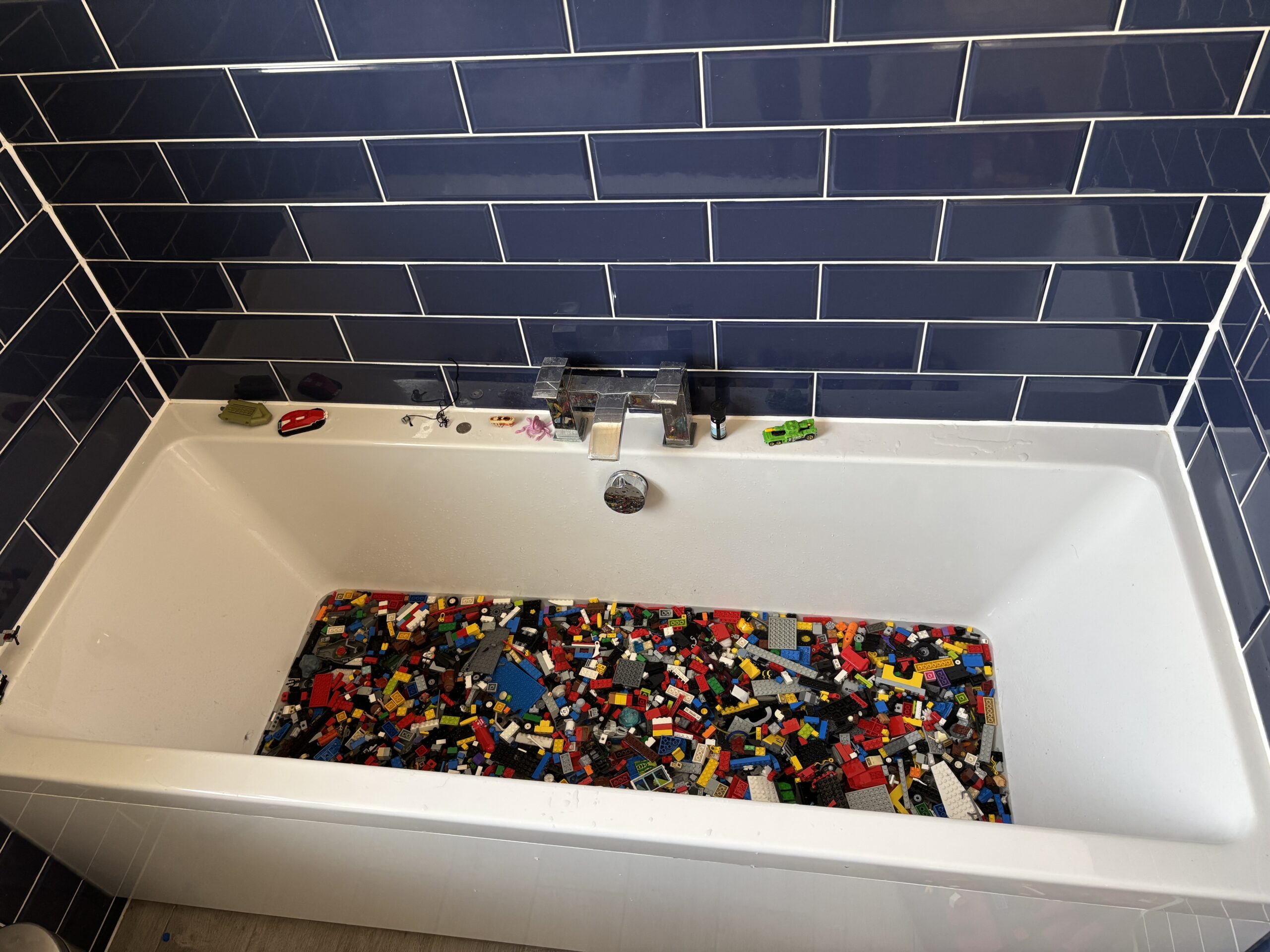
- Spent the weekend with a bath, and bathroom, full of Lego. Doing a deeper-than-usual clean of our house at the weekend, we found a tub of the stuff that had been kept without a lid and had subsequently gathered a gargantuan amount of dust. It was too good just to throw away, so my wife decided to wash it. All of it. It was the kind of job that you wish you had never started.
Media
Podcasts
- On this week’s Quiet Riot main show they asked why racists don’t like being called racist. I like their analogy:
“Racism is a little like political pornography. Its practitioners enjoy it privately or with groups of like-minded people. But if one were to start enjoying it in public, awkward questions will arise.”
- This episode of WB-40 is a very good one, with Lisa Riemers and Matisse Hamel-Nelis talking about their book on Accessible Communications. I’ve bought the book and can’t wait to read it.
Articles
- I mentioned Andrew Stellman’s article in the main weeknotes above, but it’s worth calling out twice. From Prompt Engineering is Requirements Engineering: “User stories intentionally focused the engineering work back on people and what’s in their heads. Whether it’s a requirements document in Word or a user story in Jira, the most important thing isn’t the piece of paper, ticket, or document we wrote. The most important thing is that what’s in my head matches what’s in your head and matches what’s in the heads of everyone else involved. The piece of paper is just a convenient way to help us figure out whether or not we agree.”
- Hacking a Brother KM950i knitting machine with a Raspberry Pi is exactly the feel-good technology story I needed.
- Zürich residents have voted to move to a system of car park charges linked to the weight of a vehicle. Heavier cars will pay more, with EVs paying less per kilogram. I like this thinking.
- Those silly-billies in the UK government are making a new attempt to access Apple cloud data. I really wish the government understood the implications of what they are asking for.
- People have been recording phone calls in order to sell the audio for AI training. One app that enables this, Neon, went offline after a security flaw left phone numbers, recordings and transcripts exposed. The Internet never stops surprising me with the ethically terrible things people will invent, and do, in order to make money.
- We may have hit ‘peak social media’. Everywhere except North America, that is. Global Web Index data shows that global usage peaked in 2022 and that younger age groups have reduced their time spent on social media the most.
- I enjoyed reading this interview between long-time collaborators Gabriel Birnbaum and Katie von Schleicher. They talk about mistakes they make in the recording process:
Katie: I love demos, and now I’m thinking, I should just release the demos. They’re done. And, I mean, I’m super into mistakes. It’s why I love microphonically recorded music and full takes and performances, because I love mistakes. They can change the amount of bars in a song. I would never be like, “And here’s a bar of three,” but I will fuck up and do a bar of three. You know?
Gabriel: Yeah, totally. You’re thinking about something else, drop a beat.
Katie: Yeah, exactly. And then that becomes the most precious thing.
- This reminded me of something I read in the first volume of The McCartney Legacy by Alan Kozinn and Adrian Sinclair:
Unlike other artists and producers inclined to erase extraneous noises or accidental instrumental strikes on individual tracks, Paul would leave them as they were recorded, allowing the potential to “explore the accident, not fix the mistake” as Seiwell put it. Though aiding the creative process, for Alan Parsons this posed a problem. “You try to keep the tracks clean and try to avoid having to pull down faders every time if there is a noise or a talking voice or something,” he explained. “Whereas McCartney was notorious for never allowing engineers to wipe anything, so it always made the mix take twice as long.” […] One difference, Denny explained, was serendipity—a mistake that turned out well. “Paul was playing the drums and he forgot where to come in. So he stopped and then came in a bar later. And we thought, ‘Well, that’s unusual,’ and kept it in. All these little things that happened accidentally, suddenly became part of the song.”
- I’m on my second month of paying for Simon Willison’s newsletter, effectively an edited digest of his month as an alternative to reading all of his prolific blog posts. It’s excellent, and recommended if you want to keep up with the latest in the world of generative AI. He’s landed on a definition of what an ‘agent’ is in an AI context and has a bunch of other posts in September that are well worth reading.
- “Crypto has never been about innovation, but about getting away with things you would not otherwise be able to. And it’s not just the US: while Ireland has banned political crypto donations, Nigel Farage’s Reform party just became the first major UK party to accept them, opening the door to all sorts of actors exerting political influence. Crypto was built for this. Murky dealings aren’t the bug, they’re the whole point.” — Jemima Kelly in the Financial Times.
- I see that Matthew Syed has gone full radical Conservative. He gave an excellent, inspirational keynote at the 2015 Hertfordshire School Governors conference on having a growth mindset and why it is more important for success than innate talent. Peter Walker’s comment about Syed’s speech at the Conservative Party conference being “deeply odd […], seemingly from yet another person who spends a lot of time on X” got me thinking about how many people seem to be prone to radicalisation, with social media probably being a big cause. I wonder if one day we’ll view social media like smoking.
Video
- Started watching the latest season of Slow Horses and am already enjoying being back with the characters.
- Continued with The Studio, which is super farcical and occasionally brilliant.
- Watched The Rubber-Keyed Wonder (2024), ostensibly all about the Sinclair ZX Spectrum, but actually covering Sinclair home computers from start to finish. It’s an excellent overview of what made these so great and the cultural impact they had, with an indulgent amount of footage of the computer games of the era.
- I went out for dinner and a movie with my wife and youngest son on Friday night. It was lovely to do something together instead of stumbling into a quick meal together and a night in front of separate screens at home. We watched The Long Walk (2025), the latest in a long line of Stephen King stories adapted for the screen. We weren’t too far into the film when I started wondering whether we’d actually stumbled into an 18-rated picture; it was so violent and gory. I found myself flinching and turning my head away as I knew that they would be likely to show all of the detail of someone getting violently murdered. The story was unsatisfying and felt like it could have been so much more. The absence of detail in some aspects could be interpreted as arty, allowing the viewer to fill in the blanks, but to me it just came across as half-finished. Maybe I’m just old, and this film could be exactly the sort of ‘edgy’ thing that 15-year-olds want to see.
Audio
- Had a lovely time at our WB-40 Album Club, listening to Kae Tempest’s latest album, Self-Titled. I more admired the music than got into it with my heart; there’s something about this genre where there is a barrier to me believing that it can be mine. I feel the same way about artists such as Stormzy and The Streets. Still, it’s an extraordinary work. This song Know Yourself, where Kae is accompanied by a younger version of them is incredible.
- Bought tickets to see Anna Calvi in London in November.
Web
- Five female former journalists at The Observer and The Guardian have founded The Nerve, which is worth keeping an eye on.
- Gun Violence Archive, documenting incidents of gun violence in the US, is an incredible resource.
- Someone has founded another Berkhamsted Album Club. It’s not quite the same thing as getting together with friends and listening to an album at the same time in silence, but I applaud the effort to get people to touch grass through a common interest like this.
Books
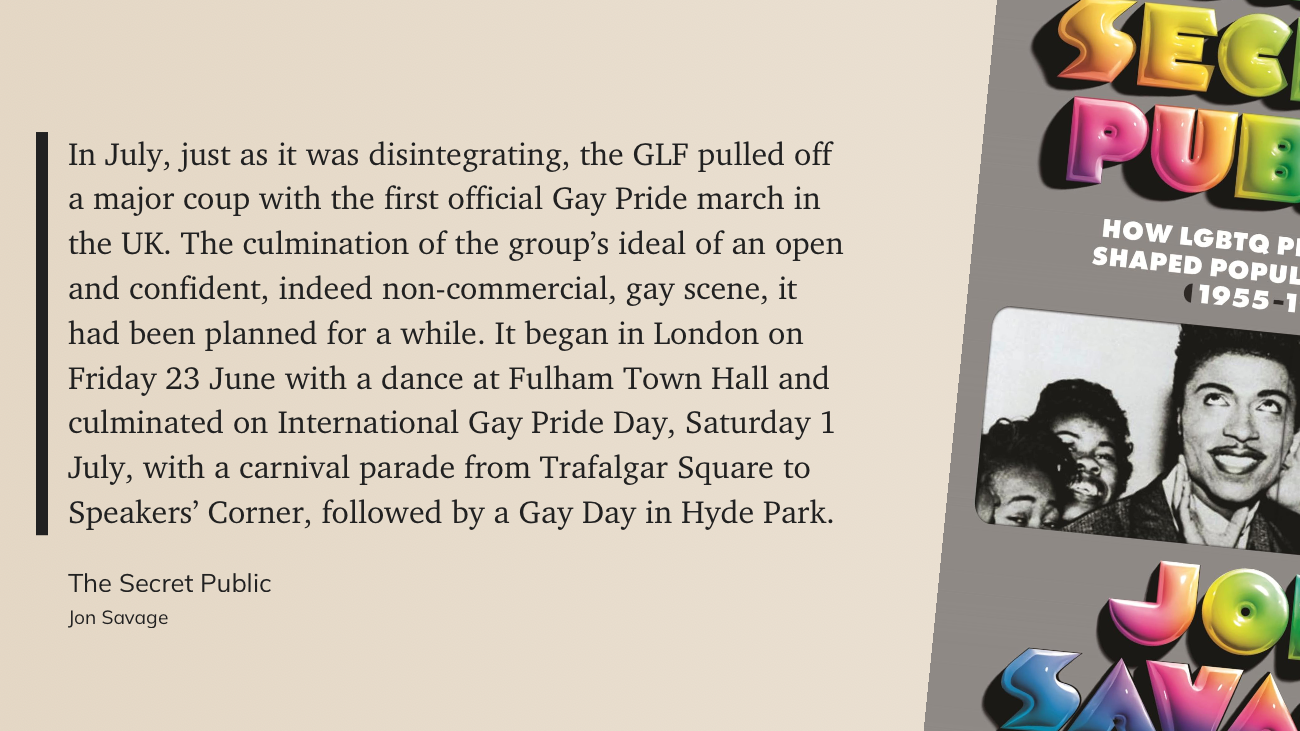
- Continued to make my way through Jon Savage’s The Secret Public: How LGBTQ Resistance Shaped Popular Culture (1955–1979).
Next week: Medical appointments, and starting to get involved in some new work.
Leave a comment