

Most of this week was spent in Barcelona at the Gartner IT Symposium/Xpo. It’s the third time I’ve been1, and I now feel I know exactly how to get the most out of my time there.

A few weeks before the event I scroll through the full schedule of the literally hundreds of sessions on offer at the conference, adding anything that looks remotely interesting to my agenda. This sometimes results in having five different things to go to at the same time, but on each day of the conference I will download the slides of each session in order to decide which one would be most valuable to attend. The ones that I missed are available in the Gartner Conference Navigator app and on their website for a little while after the event if there is anything I really want to catch up with.
As one of the largest financial services companies in Africa, our firm was well-represented with attendees from very different parts of the organisation. On Monday a few of us went out for dinner; it was great to catch up with old friends and make new ones.

I spent a lot of time at the Xpo, talking to various vendors about their products and thinking about whether they solved any problems that we have. By far the most interesting was the Island web browser. The product looks excellent and the staff were excellent at explaining and demonstrating its capabilities. I also had fun with the Chrome Enterprise team, showing them this Skeleton Claw sketch as we discussed what their offering was all about.

On Tuesday night we went out for dinner organised by Gartner with other delegates from financial services organisations in the UK. I got chatting to someone from a brokerage firm in London. Our conversation turned to cycling. Although neither of us could remember meeting, it turned out that we are members of the same cycling club, riding in the same speed group, and I already follow him on Strava. It was one of those moments where I wondered ‘what are the chances?’ But then, after thinking about it a bit more, I figured that for two people working in finance in London, living in a nice suburban town, they are probably quite high.
Our conversation at dinner turned to the topic of Chocolate Bath Olivers, which a fellow guest declared to be the pinnacle of biscuits. This is serious stuff. My scouring of the web has shown that these are almost mythical, with small production runs and nothing in stock anywhere. I’ve made a mental note and will continue to try and get my hands on some.
The conference is always a gastronomic treat and this time was no exception. As well as the seemingly endless stream of snacks and drinks, on Wednesday night I revisited Blu, a vegan restaurant that served me a black pizza a couple of years ago. This time the waiter recommended the veggie burger, which may be the best I have ever had in my life. I took one bite and then stopped to take a photo as I wanted to remember it.

The food intake was offset by morning runs. I managed to get out for a run along the coastline on three of the four mornings that I was there. The weather was perfect, not too hot or too cold, and I took in some beautiful sunrises.

Here’s a summary of the sessions I attended:
Keynote: Walking the Golden Path to Value with Rob O’Donohue and Gabriela Vogel
- I first encountered Rob O’Donohue at the 2023 Symposium. He gave a fascinating presentation on neurodiversity, but unfortunately it was scheduled late on Thursday afternoon, when most delegates had already left the conference. We’ve subsequently had him come and present to our whole team on the same topic. It was great to see that he’d been asked to give the opening keynote, which must be a career highlight for any Gartner analyst.
- I always have mixed feelings about the keynote. It’s a presentation that tries to resonate with 6,500 conference delegates from different countries and industries, each with different roles. The presentation is impeccable, but the content is often quite bland and generic. This one was about a ‘Golden Path’, which is the middle ground between AI skepticism and AI hype.
- They spoke about ‘AI Readiness’ and ‘Human Readiness’ on an X/Y axis as a ‘Gartner Positioning System’, and mapping your AI initiatives to it to see how ready you are for them.
- Enshittification got a mention, so it has clearly broken through into wider consciousness.
- The presentation seemed to assume that AI has massive value just waiting to be unlocked, but throughout the week there still seemed to be a dearth of actual case studies and use cases that were presented.
- Anthropomorphism was off the charts in the slide deck, with ghostly human-like figures made of networks of glowing dots representing AI.
- “People are discovering [with AI] what they can do, not being trained on what they should do.”
- 71% of CIOs surveyed by Gartner say that their people are not ready for AI.
- There are lots of hidden costs with AI, and companies can accidentally end up implementing projects that have negative value.
- It was interesting to see OVH, Atos and Hetzner mentioned as EMEA-based companies looking to rival the big infrastructure platforms. Data sovereignty — and, in this presentation, AI sovereignty — was a theme throughout the week. There are EMEA AI startups, but the presenters said that they are not enterprise-ready yet.
- It was interesting to hear about a Gartner study that looked at job loss data for the first six months of this year. Only 1% of those job losses were directly attributed to AI. They warned the audience about making redundancies, as Gartner still think there will not be enough skilled staff to do the work. ”Reskilling and upskilling are not perks, they are survival.” You can’t let your security and critical thinking skills atrophy; who will be happy when there’s nobody left in the organisation who knows how to code?
- I liked the term ‘behavioural byproducts’ to describe some of the effects of deploying AI tools in an organisation. It’s important to understand what people will do, and are doing, with the tools and what it means for the company.
- Resourcefulness without experience has limits and risks.
- They floated the concept of training ‘an AI’ on someone’s data — their emails, meeting recordings, code reviews etc. — where they have been with the company a while and are near to retirement. This would allow them to ‘live on’ within the organisation beyond their leaving date. It’s a fascinating idea which leads to questions of compensation and what you’re actually signing when you agree an employment contract. It completely horrifies me.
Develop Your Digital Sovereignty Strategy to Survive in a Global Market Full of Uncertainties with René Büst
- A really interesting look at geopolitical risks and what some organisations are doing about digital sovereignty. Given the move towards fascism in the US, people are now asking more questions about the risks of where their infrastructure and data is hosted, and who is managing it. As the presenter said, the trigger for looking at this in 2025 is geopolitical tensions and economic warfare. If you’re Denmark, and another country has publicly expressed a desire to annex part of your territory, you might not want to host all of your digital assets with a company located in that hostile regime.
- Getting on a sanctions list can suddenly take away your ability to use cloud services, potentially ruining your business.
- There are no guarantees that data will stay where you think it is.
- “Convenience is your enemy.” Nobody will protect your digital sovereignty. You must do it.
- Don’t confuse security or compliance with sovereignty — they are not the same things.
- Saying “no” and going your own way can be powerful in the long term. After the collapse of the Soviet Union, Finland offered its old analogue telephone exchange system to Estonia for free. Estonia declined the offer and built its own digital system. It has a very strong technology culture.
- There were lots of more recent examples, with government entities all across Europe moving from Windows to Linux, from Microsoft Office to LibreOffice or OnlyOffice, and Nextcloud.
- It got me wondering about what the UK government is doing in this space. The main things I’ve seen in the technology space with recent UK governments have focused on them wanting to get in on the AI action through cosying up to the existing, mainly US-based, companies. I really hope there’s a better strategy than this.
- Actions:
- Define your sovereignty requirements
- Specify and mitigate your sovereignty risks
- Identify areas for immediate action
- Decrease your dependencies
- Re(-design) for portability and focus on open standards
Lunch presentation with Jo Malone on Leading with Creativity
- Jo Malone is an extraordinary individual, growing up in a council house, having severe dyslexia, and leaving school at 13 to look after her mother, who had a stroke. She went on to become one of the world’s leading perfumers, founding multiple businesses. Her story of her battle with cancer, and how the pioneering treatment robbed her of her sense of smell for a long period of time, was amazing.
- My main issue with ‘celebrity’ sessions like these is that they don’t seem to fit into the theme of the conference very well. They feel like a bolt-on, without much to take away and ponder. There is something about seeing a famous name that I am sure lots of delegates enjoy, but they are not for me.

The CIO Cybersecurity Playbook for 2026 with Paul Proctor
- This was a dense presentation, with lots of material in the slides to review after the session.
- CISOs have their top priority as ‘don’t get hacked’, followed by everything else. CIOs have a top priority of ‘IT service delivery’, followed by everything else — including not getting hacked.
- The session covered the cybersecurity operating model, including whether the CIO is a cybersecurity lead or cybersecurity peer, and common areas of conflict between CIOs and CISOs.
- Gartner have a ‘Cybersecurity Business Value Benchmark’, which covers lots of the operational metrics that it would be useful to see when looking at cybersecurity performance and risks.
- Cyber risk should be positioned as a business decision and not a cybersecurity one, balancing the value of protection against the needs of running the business. It’s a choice about what we spend and the corresponding reduction in risk, but we don’t tend to treat it like one.
- A protection-level agreement can be made that balances cost versus performance, for example how often patching takes place. However, even if you had an infinite amount of money you wouldn’t necessarily patch everything within zero days as this doesn’t make sense.
- Gartner have a new tool for assessing third-party cybersecurity risk that looks useful.
Your Culture Is Shaped by the Worst Behaviours You Tolerate with Mary Mesaglio
- I picked this session primarily because of the speaker. Mary Mesaglio delivered a great presentation on How AI is Changing Human Behavior and What To Do About It at the CIO Leadership Forum in March, so I was really looking forward to hearing from her again.
- On reflection, the title of this one felt a bit clickbaity.
- It focused on three points: inspiration (new behaviours we should start seeing), inhibition (old behaviours we should stop seeing) and preservation (behaviours we should protect). I’ve always known this as ‘start, stop, continue’.
- In addition, she added two dimensions across these three points — big, department-wide messages and small, day-to-day ones. Leaders tend to overuse the big change messages and underuse the smaller signals.
- Some of the suggested example messages were uncomfortable, such as “You are not allowed to ask for approval”. I get the intent in that in this case the employee is meant to make decisions themselves with the delegated power to do so, but this isn’t the same thing as saying “you are not allowed”.
- Mesaglio highlighted the concept of ‘AI shame’ in the workplace, where people may feel that they have missed the window and are afraid to speak up. It’s part of the leader’s job to make this okay and to help equip them with the skills for the future.
AI in Action — Value, Governance and Leadership Insights with Margrethe Vestager, interviewed by Nader Henein
- This was an interview rather than a keynote speech to start the day at the conference.
- I’m not sure ‘AI in Action’ was required in the title, as this really wasn’t what the session was about.
- It was interesting to hear from a politician that had been involved in so much European litigation and legislation in relation to the big technology firms.
- She told us that she keeps a statue of a raised middle finger in her office. It was given to her by a Danish trade union when she was deputy prime minister and pushing through welfare cuts. She keeps it to remind her that her decisions will always upset some people.
Maximise Value of AI in Banking with Sophia Palmstedt
- I found this session too broad and hand-wavy, with suggestions such as “Don’t bolt AI onto broken banking processes. Instead, use AI to reinvent the process itself.”
Keynote: Supercommunicators with Charles Duhigg
- This was an excellent keynote by a superb presenter, based around his book Supercommunicators. I love sessions like this, as they give you a lot to think about and are immediately practical.
- He spoke about three types of conversations: practical, social and emotional. I immediately made the link to hearing Merlin Mann say “Do you want to be helped, heard or hugged?” on The Talk Show podcast. Duhigg went on to say exactly that, so now I’m not sure who came up with it. Either way, the advice is very good. When someone is telling you about a problem, or how they feel, it’s useful to check in on what they need. This is called the ‘matching principle’.
- He suggests asking deeper questions than ones that just elicit facts. If someone says “I’m a doctor”, don’t ask “Oh, what hospital do you work at?” Instead, ask something like “Oh, what made you decide to go to medical school?”
- Questions like these feel good to us as we are asking someone to be vulnerable.
- Vulnerability is a neural cascade that happens when I tell you something that you might judge me for.
- Duhigg gave an example of Dr Behfar Ehdaie, urologic surgeon and prostate cancer specialist, who for some patients was recommending active surveillance instead of an immediate operation. In many cases, surgery carries more risk than keeping an eye on the cancer. However, most people still opted for surgery. He found that he had to talk to the patients on an emotional level, asking “What does this cancer diagnosis mean to you?” Only then could he move on to a practical conversation about what the patient may want to do. Since he started taking this different approach, the number of patients that have opted for active surveillance has gone up by 70%.
- Duhigg asked us to talk to the person sitting next to us — in my case, a stranger — and ask the question “When was the last time you cried in front of another person?” Duhigg’s experience is that people don’t like the idea of doing this, but having done it they generally have a very positive experience and connection with the person they are talking to. He asked us to ponder what an equivalent question might be for us in the workplace.
- This question is number 30 out of 36 in the ‘fast friends procedure’. This is a set of 36 questions which have been shown to create intimate connections between people.
- Proving we are listening shows that we want to connect. To do this, remember the ‘loop for understanding’:
- Ask (preferably deep) questions
- Summarise what you heard
- Ask if you got it right
- Step three is important: if you acknowledge that I was listening to you, you are 20% more likely to listen to me.
Keynote: Never Give Up with Bear Grylls
- I was deeply sceptical about attending this keynote that started day three of the conference. I’ve never been convinced by Grylls, and his involvement in baptising Russell Brand in the River Thames less than a year after a Channel 4 documentary covered allegations of sexual assault against Brand was too much for me.
- A keynote is the only thing going on at the conference first thing in the morning, so I wandered into one of the overspill rooms to watch this one. The presentation was as trite as I thought it would be. Never give up!
How Best-In-Class Organizations Defend AI Risks with Marissa Schmidt
- This was effectively a presentation on a process to determine and mitigate risks in general, with a sprinkling of AI in there too. That isn’t to say it was bad, but there wasn’t much new to me here. You could reuse most of the content and apply it to other technologies too.
Leadership Greatest Hits — 2025 Edition: A Playlist of Actions for CIOs to Lead Better with Rob O’Donohue
- A second helping of Rob O’Donohue after the opening keynote. He is an excellent presenter, and this was a jam-packed presentation.
- The presentation used the concept of ‘Gartner’s Leadership Compass’, which shows that a leader needs to look up (at senior management and the board), down (at the people that work for them), across (the organisation), out (beyond their company) and within (at themselves). Each one of these was tackled in turn.
- He presented a smorgasbord of tactics, along with pointers to additional ones in the appendix that he didn’t have the time to go through in the time available.
- I wasn’t sure about the advice to be more aggressive in vendor negotiations, playing games such as turning up late and leaving early from meetings.
- Since 2007, the number of CIO job descriptions mentioning a requirement for social skills has increased by nearly 30%. Over this same period, the number of CIO job descriptions mentioning strength in managing financial and material resources has reduced by almost 40%. Social skills matter.
- There was a callback to Charles Duhigg’s keynote from the previous day with ‘the understanding loop’. When repeating what someone said back to them in your own words, ask “Did I get that right?”
- O’Donohue suggested putting together a ‘failure résumé’ in order to normalise failure for your people. Be honest and authentic. Don’t overthink it or dwell on negativity.
- You don’t need to be on an aeroplane to put your phone in airplane mode, getting rid of unwanted notifications for a while.
From Disruption to Direction: CIO Strategies for Leading the Workforce Through Major Change with Matt Hancocks
- That’s Matt Hancocks, not Matt Hancock, Google search engine.
- He was a good, clear presenter but I found myself sceptical of the content.
- Hancocks took us through three case studies of organisations that have navigated major change.
- The first was the Naval Information Warfare Center (NIWC) Pacific, part of the US Navy. They were trying to reignite employee engagement and came up with something called ‘The Ghostcutter Chronicles’, a fictional, serialised short story experience. They used staff interaction with this series as a way to crowdsource ideas. I have to admit that I got a bit lost with this example as it seemed overly complex and convoluted.
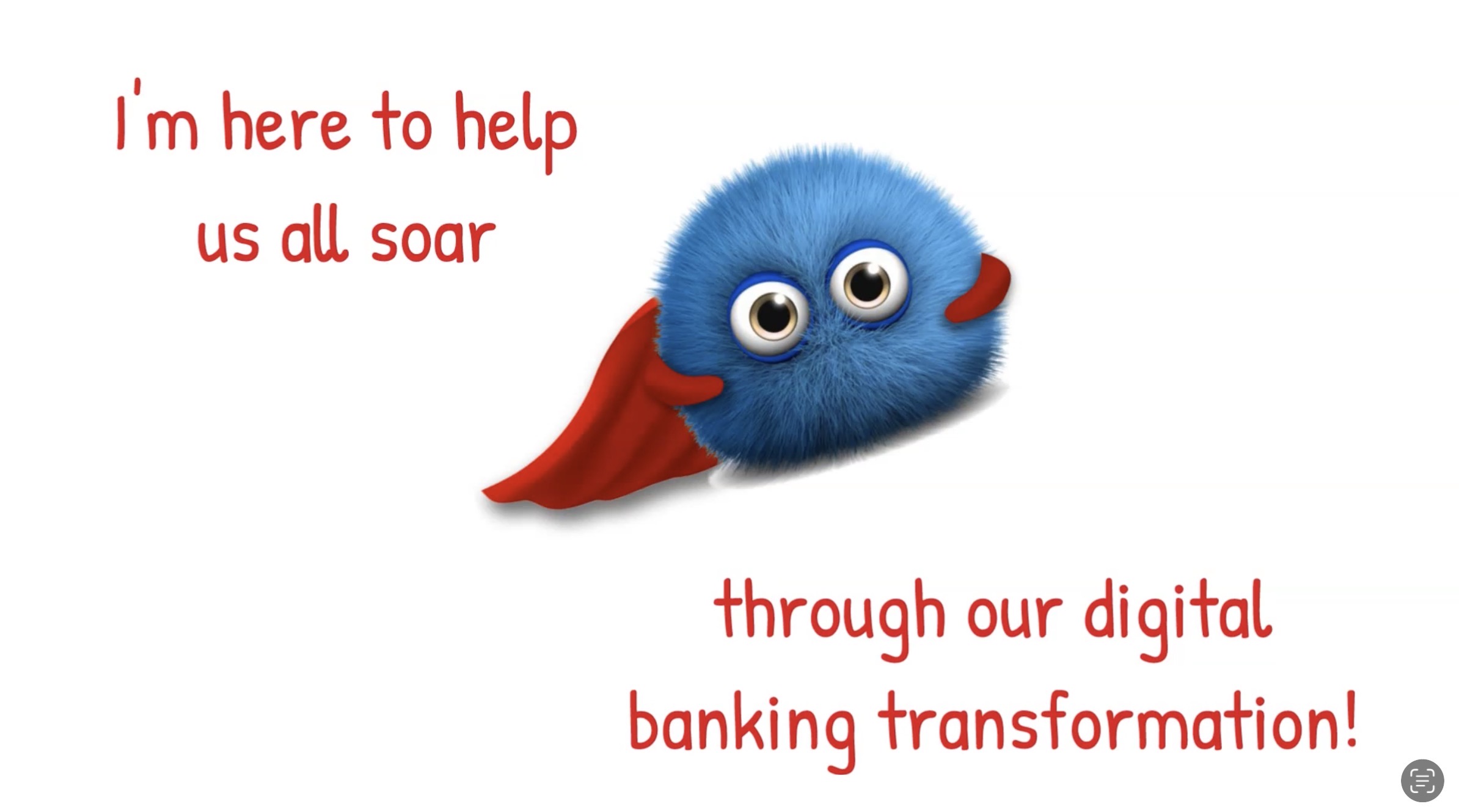
- The second example was of AAA Banking, who wanted to move from a legacy branch platform with brick-and-mortar locations to a 100% digital platform with only one physical branch. This would involve both a staff reduction and movement of staff to new locations. The way the company tackled this — and I stared in disbelief at the slides — was through the invention of a weird fuzzy character called ‘Spot’ who would be “the voice of change”, sending bi-weekly emails to employees where he answered questions, shared updates and addressed issues. ‘He’ had an inbox to receive anonymous questions and concerns, and included a ‘banking “dad joke” in every communication’. If I was going through a potential layoff, my feeling is that this would just generate anger and frustration, thinking that the leadership of the organisation was completely tone-deaf. I mean, just look at him:
- The third example was of an airline that took a more conventional approach to layoffs as they moved their systems to the cloud. They had a weekly all-hands meeting along with smaller, focused monthly ‘connect’ sessions with 10–15 people in the organisation, as well as general upskilling training for everyone. This all sounded sensible, but wasn’t revolutionary.
Keynote: Re-Wiring For The Future with Dr Michelle Dickinson
- Dr Michelle Dickinson is a nanotechnologist and materials engineer who has worked with Steve Jobs, Elon Musk and Richard Branson.
- She moved to New Zealand and created Australasia’s biggest nanotechnology lab.
- Dickinson was a good presenter and an incredible individual, but I didn’t find much to take away from the keynote that stayed with me afterwards.
The CIO Role: Navigate Evolving CIO Leadership Accountabilities with Daniel Sanchez Reina
- This was a really interesting presentation that examined the various technology-related roles that you find in organisations — the Chief Information Officer, Chief Digital Officer, Chief Technology Officer, Chief AI Officer, Chief Digital Marketing Officer, Chief Innovation Officer, Chief Technology and Innovation Officer, Chief Digital and Technology Officer, Chief Transformation Officer, Chief Data and Analytics Officer, and the Chief Digital and Information Officer, for example — and looks at how to manage the messiness caused by overlapping roles.
- “Technology leadership is distributed and ambiguous. Even in a team sport, you need clear responsibilities.”
- You need to work with other people. Leadership is about harmony, not about how loud you can be.
- He presented the concept of the ‘Technology Leadership Accountabilities Grid’, with Run/Grow/Transform on the Y-axis and Internal (back office and core operations)/External (front office and products/services) on the X-axis. You can use this to talk about where the boundaries and accountability lie between different roles.
- Things get much blurrier when more than one person is involved. Examples:
- If the CDO needs infrastructure, how will that work?
- Who looks after cybersecurity?
- These need to be written down and agreed.
- Complexity explodes with each additional technology executive. Especially when they have no budget or headcount, but responsibility for outcomes.
- Team members will need the map to see exactly where their responsibilities are.
- Tech accountability is not and will not be the same in all organisations. Value will only be achieved through the constant renegotiation of responsibilities with other tech domains.
- 65% of technology leaders want to do more transformational, client-facing things. To do this you must be good enough at your current scope and also be able to exploit your sources of influence.
What You Need to Know About China’s AI Innovations with Tong Zhang
- A lot of this content was familiar to me, probably as a long-time listener to Stratechery, Sharp China and Sharp Tech.
- It was interesting to see that consumer usage of Generative AI went from 8% in June 2024 — over 18 months after ChatGPT was released — to 43% in May 2025. This was attributed to the release of Deepseek.
- WPS is a product similar to Microsoft Office in China; it has over 600 million Office AI users.
- The presentation had lots of narrative about ‘open source’ models (but I am not sure if these should be more accurately referred to as ‘open weight’?)
Aside from attending the Gartner IT Symposium/Xpo, this was a week in which I:
- Had to manage a couple of calls and keep up with a few email threads at work throughout the week.
- Met with the company who are building our new boardroom table to give them feedback on the latest detailed design and answer their questions. The sales rep booked a meeting in my diary for Friday afternoon using the link in my email signature. This creates a diary entry with a Teams dial-in, so I was caught off guard when our office reception called me to say that I had a visitor. Everyone who was joining the meeting was working from home. We managed to quickly book a room and get him into our office so that we could all get onto the call together.
- Had the weekly meeting with our sister company about their office refurbishment project, as well as the work being done by the landlord.
- Met with our audio-visual design consultants to work through an issue related to the digital signal processor that was part of the original design. We’ve found an incompatibility between some of the components, so need to implement something slightly more complex than we had hoped.
- Made progress with my team’s annual appraisals.
- Took part in the second Society for Hopeful Technologists online event, leading one of the breakout groups through an exercise skilfully organised by some of the members of the group.
- Submitted my first-ever pull request on GitHub. I’ve recently been using the Tapestry app on my phone, iPad and Mac to have a single merged view of social media posts from Bluesky, Mastodon and micro.blog. Manfred Lizner-Scherf created a plugin that reads posts from Feedbin and incorporates them into the timeline. Unfortunately this didn’t work for me as it kept producing errors. Using a combination of the Tapestry Loom app on my Mac and ChatGPT, I managed to debug it. After testing the small fix, I submitted it back to the developer. I was a hands-on geek once, and this gave me a small taste of what life might have been like if I’d stuck with coding.
Media
Video
- Watched Human In The Loop (2024) on the recommendation of someone in the Society of Hopeful Technologists Signal group. It’s a short film that makes important points about the hidden world of the low-wage people involved in training AI systems, but some of the other elements of the story felt a bit distracting. I’d love to see a full deep-dive documentary on this topic.
- Gave up watching Being Eddie on Netflix after getting about halfway through. Eddie Murphy was a childhood favourite of mine, but this documentary is so incredibly boring. Given his significant involvement in the project, I guess it was always going to be.
- Also gave up watching All Her Fault on NOW TV after an episode and a half. The storyline is silly and the acting is super-hammy. I really struggle with watching something that is meant to be realistic but requires a massive suspension of disbelief.
Audio
- Took a trip to Deco Audio to browse their second-hand CDs, picking up four new ones for my collection.
- Cantilever looks interesting. It’s similar to how MUBI used to work for films, making a feature out of scarcity, with a new title being added and one dropping off each day.
Web
- Got this site added to powRSS. There are lots of tools now available for discovering blogs and blog content. I like the feature of this one where you can get sent to a random post from any time in the past on any of the blogs in the database.
Books
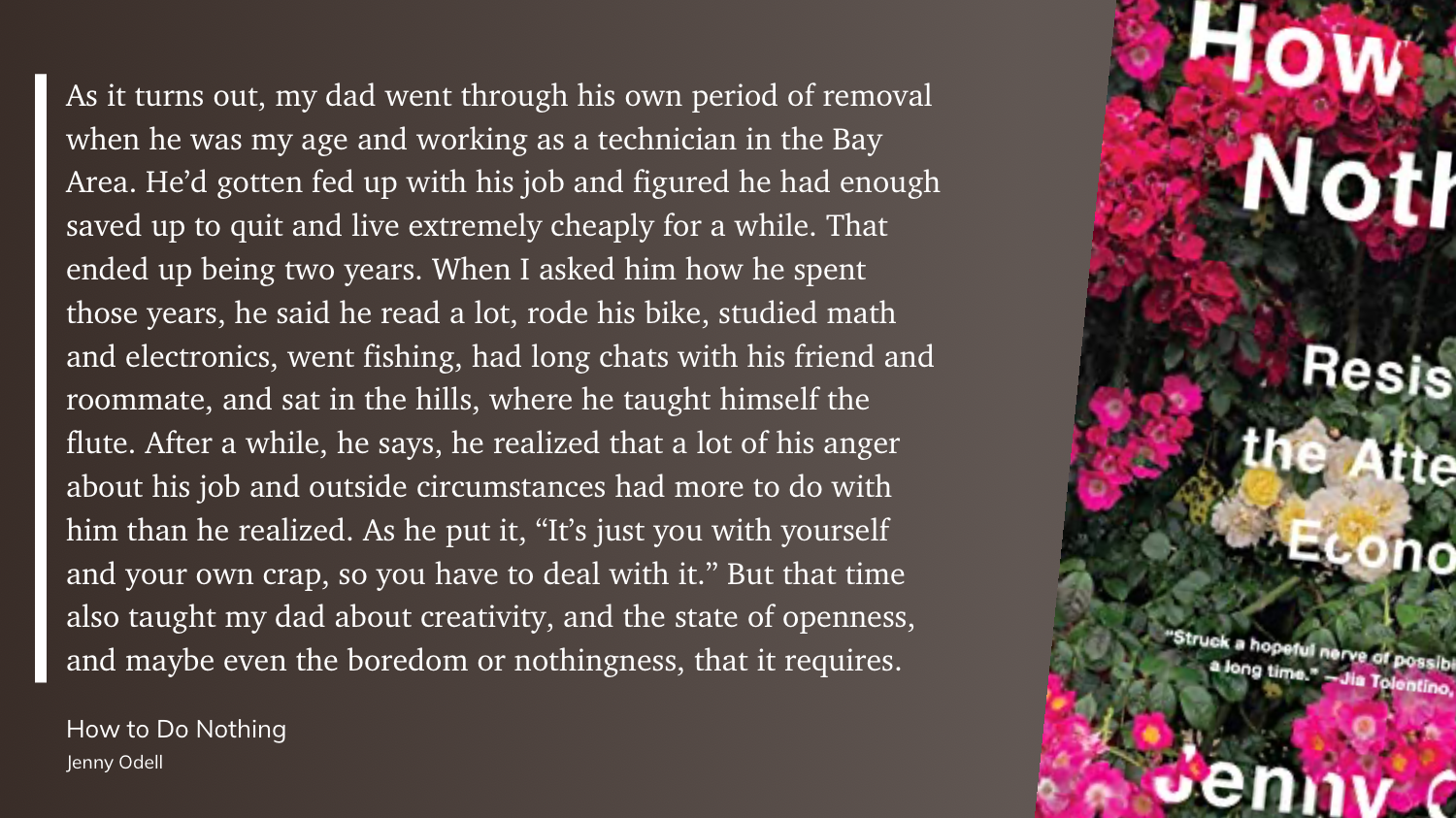
- Have been enjoying Jenny Odell’s How To Do Nothing: Resisting The Attention Economy. It’s super well-written and rewards longer reading sessions.
Next week: Back in the office, and a couple more online meetups.
Leave a comment