
Over the past few years, I’ve seen some wonderful tools sprout up that encourage and facilitate the exploration of independent websites and blogs. These are fun and useful places to explore, helping you to dig around corners of the Internet that otherwise may not be surfaced through the big search engines or AI chatbots. Browsing these sites, finding interesting feeds to add to my RSS reader, feels like a healthier way of spending time than scrolling through social media.
Here’s a list of the sites I’ve been enjoying, in no particular order:
ooh.directory

Currently, ooh.directory has collected “2,356 blogs about every topic”. The main index is presented in a Yahoo!-style taxonomy (if you are old enough to remember this), allowing you to dig into, for example, ‘Economics and business’ and then further down into ‘Companies’, ‘Personal finance’, ‘Venture capital’ etc. Kids — this is one of the main ways that we used to find websites before Google showed us what a good search algorithm could do.
The front page highlights blogs that have reached a significant birthday, have posted for the first time in a long while, or have recently been added to the database. You can browse blogs by how recently they have been updated or by how new they are to the directory.
Every blog has its own listing with useful information, such as when it was last updated, roughly how many posts are made per week, where the blogger is based and a link to the RSS feed.

powRSS
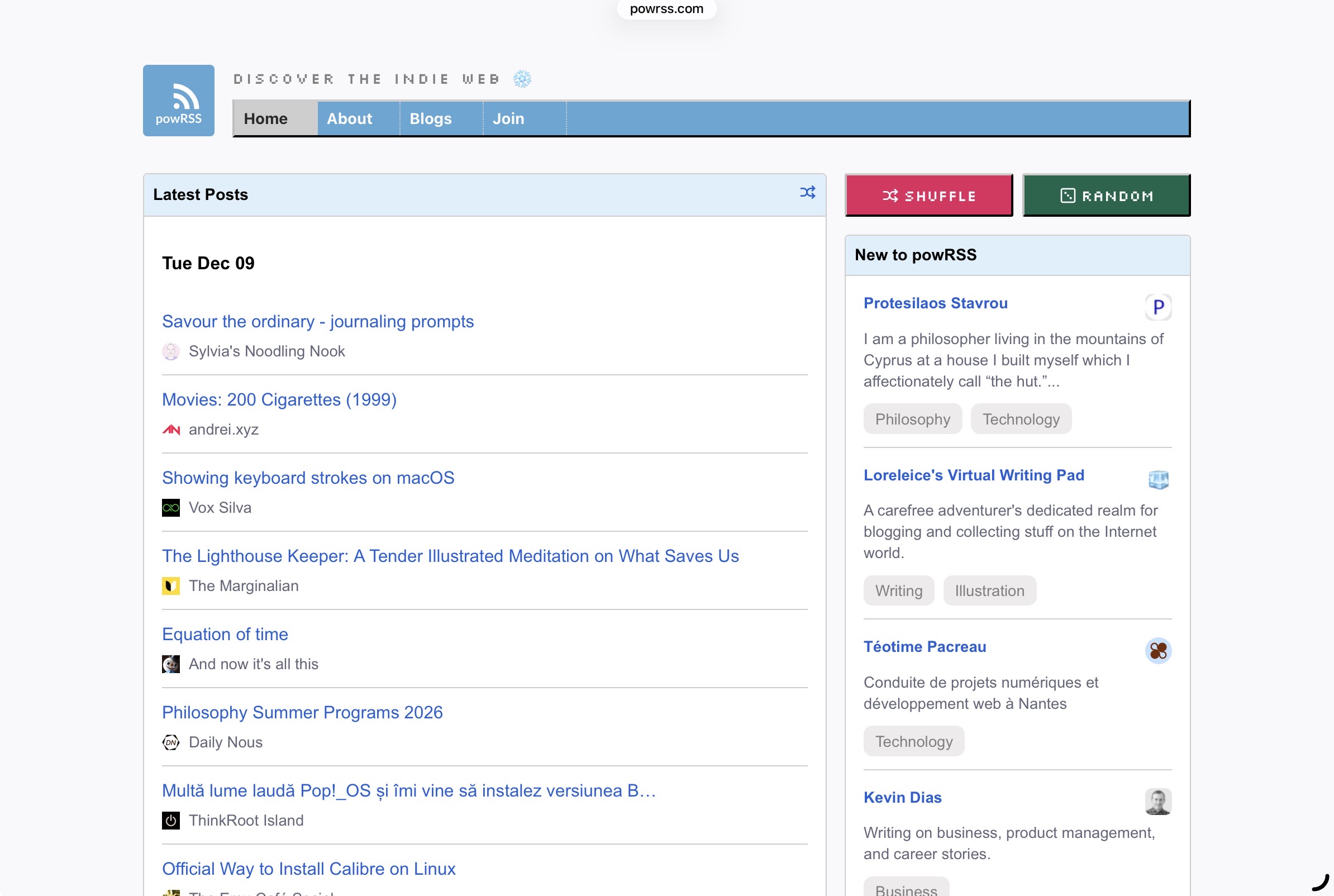
powRSS is another directory of blogs. It doesn’t have a taxonomy like ooh.directory, but it does have some unique features which make it interesting.
The homepage shows a list of the latest posts from the 331 blogs in the database, along with a list of blogs that have recently been added. Pressing ‘shuffle’ randomises this list, and hitting the ‘random’ button will result in you being taken to a post from all of the sites in the directory, from any time in history — not just the latest from a particular blog.
Ye Olde Blogroll

Blogs sometimes include a ‘blogroll’ on their site, which lists other blogs that the author enjoys. In the sidebar on my site, I’ve listed a few blogs that I follow, as well as fellow weeknoters and some blogs that I enjoy so much that I’d like to read them in their entirety. Ye Olde Blogroll, at blogroll.org, takes this concept and makes a whole site out of it, listing 1,067 blogs in a big list. You can filter by some broad topics to find some interesting places to visit. It’s a beautiful-looking site.
Some of the blogs are flagged as ‘supporters’, contributing $1/month to the site. Many of them are flagged as ‘interviews’. Site host Manuel ‘Manu’ Moreale is curating a newsletter series called People and Blogs where he interviews bloggers about their sites. They are posted to his own blog as well as the dedicated newsletter site.
All of his work is gorgeously designed and is a joy to read on the web.
searchmysite.net

For as long as I can remember, I’ve always reached for a search engine that prioritises results from blogs and the IndieWeb. I’d regularly use tools such as Technorati or Daypop to hone in on articles written on small websites. Google used to provide its own blog search tool, until they killed it like so many of their products. searchmysite.net gives you the ability to search posts from all of the 3,455 sites in its index.
indieblog.page

Similar to the ‘random’ button on powRSS, indieblog.page gives you a button to click that will take you to a random blog post. It also keeps track of posts that you recently saw, in case you want to revisit them or subscribe. At the time of writing there are 4,955 sites in the database and over half a million posts. You can also search these posts in a similar way to searchmysite.net.
Scour

Scour is an interesting tool that asks you to state your interests and then surfaces posts from web feeds that are related to these topics. It goes beyond the IndieWeb but is useful at surfacing posts and articles that might not be that visible or popular.
Topics are free-form and don’t need to come from a list. The site uses a large language model to interpret what it is you’re looking for and how well blog posts match those phrases. So, for example, I can just as easily say that I am interested in ‘AI use in investment banking’ as I can ‘weeknotes’, ‘internet culture’ or anything else I can think of.
It does an excellent job of finding posts to read based on your interests. All of the content is assembled into a personal ‘Top Finds’ page which you can filter by what’s ‘hot’ now, or has been posted in the past hour, day, week or month. You also get a weekly ‘digest’ email with your Top Finds.
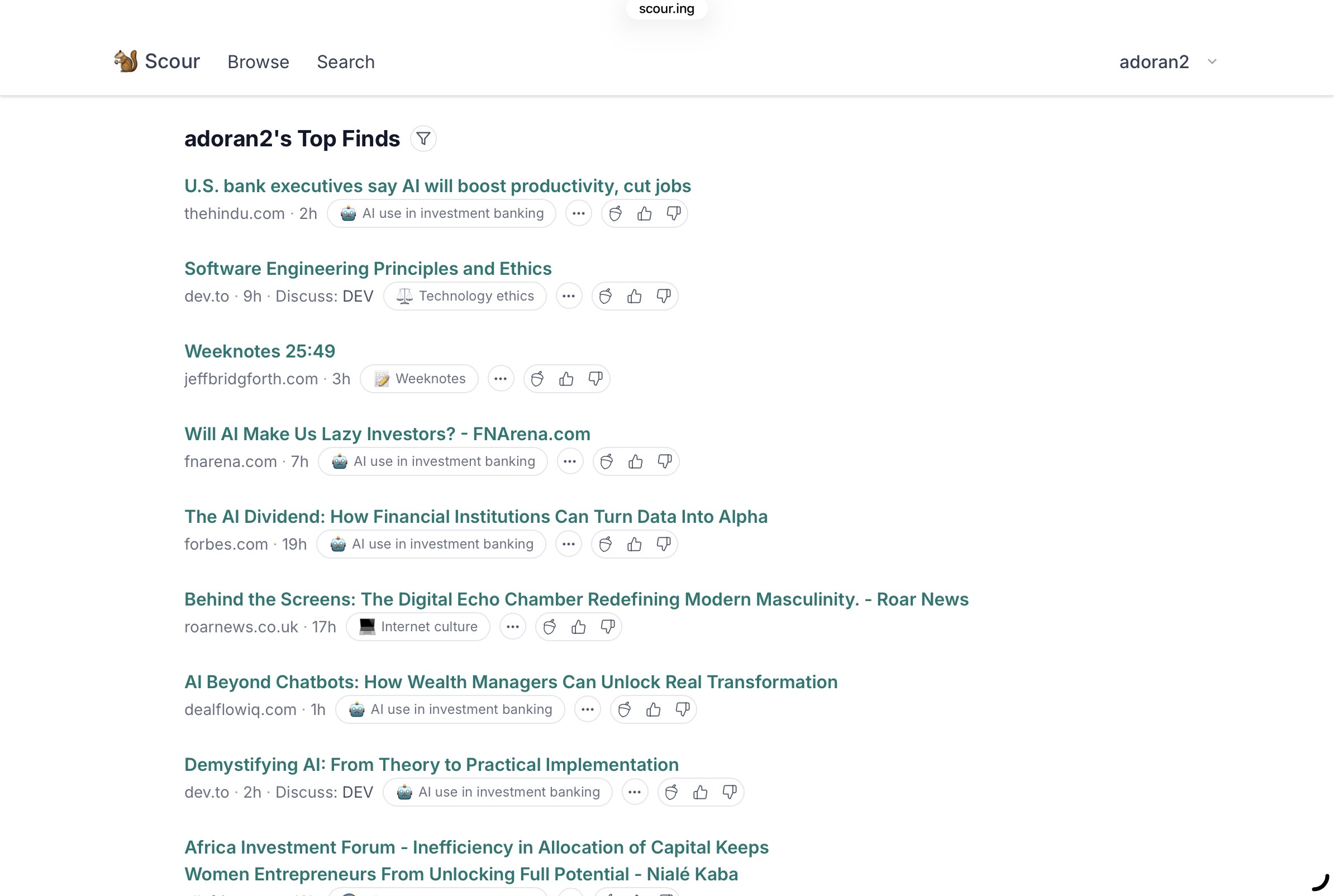
You can also browse other people’s pages — here’s mine, for example — and even ingest those pages as RSS feeds into your feed reader. You can also see popular posts and interests across the whole tool. Other features allow you to hide paywalled content and exclude domains. It’s very cool, and a great use of AI.
Leave a comment